‘We can’t let homophobes win’: taxi driver ‘sped up’ when seeing her cross the road with her partner.
“Caoimhe, who is known on stage as Freya Femme, said the driver shouted homophobic insults at the couple after narrowly avoiding them.
Writing on the Cork subreddit, Caoimhe claimed: ‘A taxi driver, in his taxi with another person, they were waiting to cross the road.
‘He waited for us to be in the middle and then sped the car towards us threateningly to make us run and shouted homophobic things out the window at us.”
Catholic nun, gay and militant. Bridget Coll, Irish born but a proud Canadian, was a trailblazer.
She and her partner, Chris Morrissey, made history when they challenged Canadian immigration law which had only recognised heterosexual married partners.
As nuns in the 1980s, they stood with the oppressed in Chile against dictator Augusto Pinochet’s regime.
Hers is an inspirational journey. She travelled thousands of miles in just one lifetime.
Now, her story features in a new exhibition in Dublin telling the stories of Ireland’s LGBTQ+ diaspora.
Bridget died in 2016. Her life partner, activist and former nun, Chris, survives her.
Historian Dr Maurice Casey, who curated the exhibition, came upon their story by chance. He had set out to celebrate an LGBTQ+ history of the Irish emigration story.
There is wit and wisdom, a generosity and a humility about Bridget Coll that shines through on the tape recordings from 12 years ago.
She talks about how she was born in Donegal in 1934, one of 12 children from a Catholic family who grew up near Fanad lighthouse. She never questioned her sexuality.
At 14, she wanted to be a nun and at 16, joined an order in England.
From there, she went to America to work for the Franciscan Missionaries of St Joseph.
That was where the first seeds of dissent were sown.
“There was an encyclical on birth control from the Pope. The priest gave a whole sermon from the pulpit about how it was a real bad thing to do,” she said in the recording.
“I had a lot of contact with mothers of kids that I taught. They would come and tell me their stories about birth control. I listened to the women’s stories and their hardships.
“For the first time in my life, I began to doubt the teachings of the Church.”
She was drawn to read more about social justice and liberation theology – a radical movement that grew up in South America as a response to the poverty and ill-treatment of ordinary people.
The Liberationists said the Church should act to bring about social change and should ally itself with the working class.
It was at that time that Bridget became close to Chris, a Canadian nun in the same order.
When Bridget’s parents died within weeks of each other in 1977, Chris was the one person who truly helped.
“She said she was a lesbian and asked: ‘Do you know what that is?’ I said: ‘No’.
“She said: ‘I think you’re a lesbian’. I didn’t know the word – that was the first time I knew.
“It was 1977, I was 43, that’s the first time I ever heard it and the first time I fell in love with a woman.”
Two men have been arrested and charged in connection to the killing of out lesbian journalist Lyra McKee, who was shot to death while covering a riot in Northern Ireland two years ago.
“These arrests are the culmination of a detailed two-year investigation into Lyra’s murder and the events which preceded it,” Police Service of Northern Ireland Detective Superintendant Jason Murphy said in a written statement. “The local community have supported the Police Service of Northern Ireland throughout the course of this protracted investigation, and I wish to thank them for their continued support.”
On 1 August 2021 Listening2Lesbians provided submissions in response to the following from the Commission on the Status of Women:
“Any individual, non-governmental organization, group or network may submit communications (complaints/appeals/petitions) to the Commission on the Status of Women containing information relating to alleged violations of human rights that affect the status of women in any country in the world. The Commission on the Status of Women considers such communications as part of its annual programme of work in order to identify emerging trends and patterns of injustice and discriminatory practices against women for purposes of policy formulation and development of strategies for the promotion of gender equality.”
Information was provided to the UN on incidents dating back approximately 2.5 years across the 57 countries we have reported on in that time.
Legal, social and familial punishment of lesbians for failing to conform with the expectations imposed on women illuminates the status of women around the world. Homosexuality is understood to be a breach of sex-based expectations. Strictly enforced sex roles are accompanied by increased consequences for those who break them, individually or collectively. Lesbians, or women read as lesbians, are doubly punishable for their non-conformity, both overt and inferred.
Listening2Lesbians is not an expert on these countries and provided this information to augment and support the information provided by women from individual communities. We can only provide information on cases we have been able to locate and based our submissions solely around the available facts. Please note that we welcome corrections and updates.
We are painfully aware of the many communities not represented.
Anyone with information on missing communities is invited to contact us with information on reporting violence and discrimination against lesbians in their community.
In April 2019, an International Protection Officer (IPO) recommended that the woman – who has not been named – be denied asylum, arguing that her claim lacked credibility.
The woman said she forced into two separate marriages as a child in Zimbabwe at the ages of nine and 13. She claimed she was forced to flee her home country after her family found out that she was a lesbian, leading to threats of violence.
The woman subsequently brought judicial review proceedings in an effort to have the 2019 IPO recommendation overturned – however, Justice Tara Burns denied her request on Friday (22 January), The Irish Times reports.
In her appeal, the woman argued that her sexuality was a “core element” of her asylum claim and that the IPO had failed to determine her sexuality when it recommended that she be denied asylum.
Before making a recommendation on her asylum claim, the IPO asked her questions about her sexuality and found that she was not aware of any LGBT+ support groups in either Ireland or Zimbabwe.
A LESBIAN couple in West Limerick are living in ‘hell’ following a campaign of homophobic abuse that has been directed at them, which saw them assaulted in front of a five-year-old child of one of the women involved.
The couple say during the attack they feared for their lives, due to the violent nature of the assault.
“They were all around us, attacking us. They pulled out lumps of our hair. We both knew that if we fell to the floor, we were dead.”
This is the second assault of the kind the couple has faced, with one of the women attacked on the street earlier this year. They feel as though they are being forced out of their home.
A video has emerged that shows a Free Presbyterian minister criticising the DUP for selecting Alison Bennington to stand in the council elections.
Ms Bennington, the DUP’s first openly gay politician, was elected to Antrim and Newtownabbey Council on Friday.
In Rev Greer’s sermon from 21 April, prior to the local government elections, he said that Christians were “being conditioned into thinking that things that were once reprobated are now acceptable… such as sodomy.”
He described that as an “agenda”.
“Now we have the DUP putting up their candidate, who is an out-and-out lesbian, that’s what I mean,” he said.
Lyra McKee was killed on Thursday (local time) by a gunman shooting in the direction of police officers, shortly after she tweeted a photo of a police vehicle being pelted by petrol bombs, with the caption: “Derry tonight. Absolute madness.”
A year after moving to Londonderry, the celebrated young journalist had written about how she looked forward to “better times ahead and saying goodbye to bombs and bullets once and for all”.
But just three months later she was killed during a riot that underscored the challenges still faced by Northern Ireland, 21 years after the Good Friday Agreement largely ended decades of deadly sectarian bloodshed.
A woman sustained a circular hole in her skull when she was attacked with part of a drill during a suspected homophobic attack in Northern Ireland, police have told a court.
Brenda McLaughlin told officers she believed she was targeted on Saturday because she is homosexual and it is being treated as a hate crime.
Little Griffin was then born in August after the newlywed couple’s third IVF attempt was successful.
But only Holly, 31, was marked as his mum on the birth cert — with Katie, 34, from Gweedore, Co Donegal, put as a generic “parent”.
However, Irish laws from 1956 define a parent as only a child’s “mother” or “father” and the Passport Office refused Katie’s application for 11-week-old Griffin.
“Lesbian sexual identity and choice is being eroded, erased and elided. This is being done by the literal obliteration of lesbians by state-sponsored violence, by the “corrective rape of lesbians” (imagine the 12 year old Pearl Mali being given the worst sort of reparative therapy by her very own mother), by the harassment and violence, by the firings (lesbians face more job discrimination than any other group within the LGBT alliance), by the enforced and compulsory heterosexuality of every society on earth. Aderonke Apata has been forced, by men, to provide not just spoken testimony and a pending marriage license, but also a sex tape of her having sexual relations with her partner to “prove” her lesbianism to the men who want to erase that aspect of her identity–the very identity that puts her and millions of other lesbians at risk of imprisonment and/or death.”
She described her wife as a fearless “champion of equality, fairness and justice” and said she was a tireless campaigner who “through the courts, the Oireachtas and ultimately on the doorsteps” helped to secure marriage equality in Ireland.
It’s nearly 40 years ago but Joni Crone still remembers the “whoosh” of the studio lights seeking her out and her stomach churning fear as she waited for Gay Byrne to tell her relatives, neighbours, work colleagues – and the nation – that she was a lesbian. A sympathetic member of the Late Late Show team had given her a double vodka when she wondered if she was about to be the first person to faint on live TV. “He held my hand and said ‘trust me’. He told me I’d be grand, to just look Gay in the eye and to forget about everything else”.
It was 1980, two years before Declan Flynn, a gay man, was beaten to death in Fairview Park in Dublin. Homosexuality would be regarded as a crime for another 13 years. Crone was there to talk about the need for law reform and to give an insight into the horror stories she regularly heard on the helpline Lesbian Line, where she had once listened in as a whispering caller was interrupted and beaten in her own home. That caller rang back from a hospital corridor days later. Crone wanted to give out the telephone number of the helpline on the show so people like her would have somewhere to turn.
A gay Irish woman has taken legal action against a former partner in a bid stay in touch with a girl.Her former partner had given birth when the two women were living together in Ireland after the little girl was conceived through artificial insemination.They separated, and the Irish woman’s partner had moved to England and taken the little girl.
The five Chinese feminists, including lesbian feminist activist Li Tingting, detained just before International Women’s Day have now been freed on conditional release.
Laws, Politics and Policies:
Leading child welfare organisations and the Humans Rights Campaign jointly denounced a Florida anti-LGBTI adoption bill and religious freedom bills across to country on the ground of the harm they could do to children, both in terms of promoting homophobic messages and in the withholding of vital services.
Continuing the worsening state of LGBT safety and protection in Egpyt, the state has now been granted the right to ban or deport LBGT foreigners. It’s not entirely clear how this measure will be applied across the LBGT community. Egyptian lesbians face additional barriers including silencing and invisibility, as well as the rampant sexual violence against women, which would also affect lesbians visiting Egypt.
In Italy, a woman’s relationship ties to the children born during her relationship have been recognised in a court case that granted shared custody, which is significant in a country with a lack of legal protection for the relationship between children and their non-biological lesbian co-mother.
A South African discrimination case has been settled with the owners apologising for the consequences of their refusing accommodation to a gay couple. It was acknowledged that the matter was small compared to the violent homophobia may LGBT South Africans face but that it was a part of the broader picture of addressing dehumanising treatment of lesbian, bisexual and gay South Africans.
Representation:
Lesbian suicide is a neglected issue in India with a toxic combination of blatant lesbophobia in Bollywood and minimal representation, with reporting of lesbian suicides not including supporting information or openly reporting the facts of stories. A country of over 1.25 billion people, India seems to have only 5 organisations supporting lesbian and bisexual women, reflecting their lack of visibility.
Organisations representing lesbians in the tech field work to support women who are significantly less satisfied with their jobs on average and receive lower pays. This support includes mentor programs.
More reflections on poor lesbian representation as yet another lesbian relationship on TV succumbs to the mad, bad, sad or dead cliché. This may look like an unimportant issue to those who have thousands of (diverse) examples representing them, but this is far from the case for lesbians. Movies are no better, with only 17.5% having any LGB representation, mostly minor or token roles.
South African photographer Zanele Muholi sees the role of her exhibition to be to bear witness, saying “Looking at where we’re at right now in the struggle [against homophobic violence], there’s nothing to laugh at, there’s nothing to enjoy except when one is intimate with her lover. I ask my sitters to think about the situation, think about being black, being a lesbian, being a woman.”
Night Fliers is a film by Sara St. Martin Lynne which can be watched here. Sara St Martin Lynne says of the film: “My friends and I saw very few reflections of ourselves and our friendships and romantic interests in the media. Night Fliers is free because it should be seen by the young people for whom it was made, regardless of an ability to pay a rental fee. In 2015, 60% profits for this film will be donated to organizations and projects that directly impact and empower girls.”
Bullying remains a significant issue for LGBT youth with a CDC study finding that 12-28% of LGBT students had been threatened or injured at school in the previous year, and a 2011 study showing that 82% had reported problems with bullying overall. A recent study found that peers were most likely to intervene in homophobic bullying based on “the values of altruism, leadership, courage, having LGBT friends, and beliefs in justice.”
A new book Ravensbrück: Life and Death in Hitler’s Concentration Camp for Women explores the forgotten victims of Ravensbrook which notably included lesbians in the Nazi concentration camp built specifically for women.
An Iranian Ayatollah has blamed homosexuality on bizarre causes including a man thinking of a woman other than his wife when she conceives and women not wearing the hijab correctly. Iran remains a dangerous country in which to be lesbian, with four counts of sex between women being punishable by death.
Mary Kristene Chapa and Mollie Olgin (Image source: Curve Magazine)
In an example of an appalling hate crime in 2012, two two young lesbians went on a date but were viciously attacked. Mollie Olgin was killed and Mary Kristene Chapa was left for dead.
Their attacker was arrested in 2014 but was not charged with a hate crime, despite sufficient evidence to justify it.
Despite the horror of the crime, Mary Kristene Chapa’s medical fund has only raised $12,882, compared to the over $800,000 raised for Memories Pizza, the pizzeria that declined to cater same sex weddings.
Horrific anti lesbian crime occur routinely and they are not reported. When they are, this is the level of interest they garner.
There seemed to be surprisingly few violent crimes reported against lesbians this week. Given what we know about crime against women and specifically lesbians, it seems unlikely that the crimes have ceased, and more likely that the crimes are either not reported or the reports are not making it to the mass media. How do we change this and how do we access accurate information about violent crimes against lesbians?
The Obama administration has called for an end to conversion therapy for lesbian, gay and transgender children. Conversion therapy for lesbians and gay men has a dark history from elimination of “inversion” to ongoing Christian conversion practices. These practices were and are about enforcing gender conformity and discouraging gender non conformity through the linking of sex and required behaviours and attributes (sex stereotypes), and are primarily aimed at eliminating homosexuality. A concern about any concrete bans on all forms of therapy is that it could inadvertently ban the kind of counselling that children diagnosed as transgender may need given that 75-80% of transgender children go on to be not transgender as adults but predominantly lesbian and gay. These children, in particular, need access to supports that validate gender non conformity and homosexuality in the absence of any broad media representation or social acceptance.
Tulsa looks to introduce specific sexuality based protections to ensure the city’s fair housing policy extends to protect lesbians and the rest of the LGBTI community. A recent example demonstrating the need was a married lesbian couple with children who were told that to process their mortgage application, they would have to disavow their relationship.
A Colombian lesbian adoption court case highlights the mixed picture for lesbians in Latin America. What is curious is how many of these articles reference same sex marriage as if that is a panacea to the structural oppression, social exclusion and sanctioned abuse and violence lesbians face around the world.
Kathleen Wynne, Premier of Ontario, Canada and first lesbian Premier, says being lesbian makes her feel more responsible: “It is part of who I am and it is important for me to be clear that I have a responsibility because of who I am . . . to make our society safer and more inclusive”.
Two organisations, NCLR and the National LGBTQ Task Force have removed their names from the Equality Michigan petition calling on the Michfest to include transwomen, without having changed their opinion on inclusion. To a non-American the choice of a single (less than) week-long woman’s music event as the symbol of well being for transwoman seems odd in the context of employment discrimination and abuse.
Photographic Series “Happy Lesbian Couples” shows, well, happy lesbian couples. Whether you believe this is an argument for marriage equality or not, positive humanising representation in itself is important.
Mad, bad or dead: why do we have the Psycho Killer Lesbian plot back again? “The pathology linked to the lesbian is actually a displacement of the feared pathology of patriarchal culture… The very challenge to order contained in representations of lesbians is restrained by depictions that, in their evocations of nonsense or pathology, disenfranchise the out-of-the-law as the outlaw. This is why lesbians are often figured as murderers and vice-versa. The murderous lesbian characters in Paul Verhoeven’s BASIC INSTINCT (1992), as well as the association of lesbians with vampires…highlight fears that lesbians threaten the death of patriarchy.” Are male supremacy insecurities at the heart of this familiar trope mixing fear and fetish?
Love it or hate it – do we need another (better) L word? Are we better served by individual characters in mainstream television or entire shows about us? Perhaps we need both, and to ensure that they are more broadly representative of our diversity than the narrow range of representation we have seen before? Do we know what good representation looks like?
On a really trivial front, LGBT emoji have come to iOS but what do they look like? We have identical blondes in pink dresses and women in bunny ears doing synchronised dancing…
After a public outcry, Louisiana Teen Claudetteia Love has been told she may wear a tuxedo to her school prom. Originally the student had been advised that she was not allowed to wear a tuxedo to the prom as part of gendered dress codes that require girls to wear dresses.
In Japan, same sex wedding ceremonies are gaining greater acceptance, despite the ongoing difficulties same sex couples experience in their daily lives, posing the question of what the link is between broader acceptance and marriage equality…
***If I have missed an important news story, please either post a link in the comments section here or email it to me at liz@listening2lesbians.com.
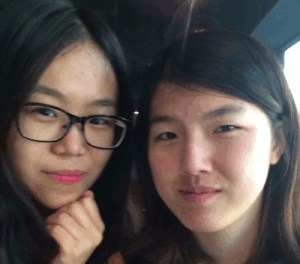
Xiao La and Maizi, image courtesy of Amnesty International
Li Maizi, formally known as Li Tingting, was arrested for “causing arguments in the street” in the leadup to International Women’s Day. Her girlfriend, pictured with her above, is calling for help through All Out:
My name is Xiao La, and I live in China. Two weeks ago, Maizi was organizing a peaceful protest with four friends to denounce harassment at work. They were making pro-equality stickers and planning to hand them out. And just for that, Chinese authorities put my girlfriend in jail.
My birthday is today. Maizi and I had planned to spend the day together doing romantic things. My birthday wish is to have Maizi back. Alone, I won’t be heard. But if thousands around the world join us, the global outcry could get her out of jail.
Maizi and I were taken by the police together, but I was freed the following day. Authorities can now hold her for up to 37 days before deciding whether to even charge her. The authorities confiscated her computer and her phone. The worst part? It happened the night before International Women’s Day.
The Brutality of Corrective Rape – South Africa’s progressive laws give no indication of the deep homophobia still dominant within the country, according to this New York Times article. The endemic violence against women couples with the homophobia to result in virulent lesbophobia and, more specifically, corrective rape. Whether it is based on male sexual entitlement or a so called desire to change their sexuality, these South African women talk of being subjected to socially sanctioned and repeated rape. Women are murdered and women have resulting children withheld because of their sexuality.
Homophobia fears keep violence victims quiet – the multiple silencing of same sex domestic violence that prevents victims seeking or receiving help. What can we do as a community to better address the needs of victims? (Note: this story has some Australian DV assistance links).
Conversion therapy and social homophobia:
“Dehomosexualisation” centres in Ecuador – these abusive clinics are practically unregulated, and their practices extend to “the use of restraints, tranquilizers, beatings, withholding food, solitary confinement, water bucketing, and other forms of degrading treatment.” Victims are tricked or forced there by families and may be there “until they change”.
Victoria Brownworth’s new novel Ordinary Mayhem is released, focussing on violence against women. Victoria Brownworth’s next book Lesbian Erasure: Silencing Lesbians will be released in late 2015. She says of the novel:”For the past several years I have been increasingly concerned by the obliteration of lesbians as a group by mainstream culture, mainstream feminism and regrettably, even by our own community,” she said. “Major online publications like Slate and Salon conflate lesbian into gay, as if lesbians and gay men don’t have separate identities. And increasingly there is also a revision of butch lesbians as trans men when that is rarely the case—that makes both butch lesbians and trans men invisible. Not all trans men were lesbians, not all butch lesbians are closet trans men. Let each have their distinct identities.””Corrective rape was invented specifically to teach lesbians a lesson about heterosexual normatively. While it’s most common in South Africa, India and Jamaica, it also happen in the U.S., Europe and elsewhere. There are 78 countries where it is illegal to be lesbian or gay—specifically. Lesbians are the victims of honor killings in a dozen countries. The forced marriages of lesbians to men happens in several dozen countries. These are some of the things I write about in Erasure.”
The Atlanta Pride School will open this summer – the first specifically LGBTI school in a state with “no statewide anti-bullying or nondiscrimination laws that protect LGBT students”. Should we really have to do this? Is this the best use of small amounts of funding or could we instead be agitating for legal protections for the thousands of children who cannot access this school? Thoughts?
***If I have missed an important news story, please either post a link in the comments section here or email it to me at liz@listening2lesbians.com.
Corrective Rape: “I became their playground” – a short film exploration
“Corrective rape, the attempt to cure lesbians of their homosexuality, is escalating in severity in South Africa. This film explores the phenomenon through the story of a gay single mother from near Johannesburg. Busisiwe’s five children are all the offspring of corrective rape. As a lesbian, she was raped in order to be ‘cured’ of her homosexuality. Despite that they’re a product of the hate crime, her relationship with her children is not destroyed: “I only want them to succeed in life, to have the things I didn’t.” In Gauteng near Johannesburg, crime and violence are on the increase and life is tough. With the courage found in her children, Busisiwe helps to educate the young about being safe on the streets.”
“Jean was a force in the lives of all who knew her. A visionary, she anticipated many of the political and economic shifts the country has endured over the past several decades. Undaunted by the implications of her insights, she dedicated herself tirelessly—and with uncommon skill, humor, and compassion—to the cause of social justice. She was a friend, mentor, colleague, and inspiration to us, and to countless people and organizations.”
Researchers discovered that the inaccurate assumptions by doctors about the sexual history of women in same sex relationships resulted in fewer health screenings for lesbians than straight (or bisexual?) women.
The human papillomavirus is the leading cause of cervical cancer and is most commonly transmitted during heterosexual intercourse but can also be transmitted orally and through skin-to-skin contact.
Please be aware of your risk factors and get health screenings as required.















 Listening to Lesbians