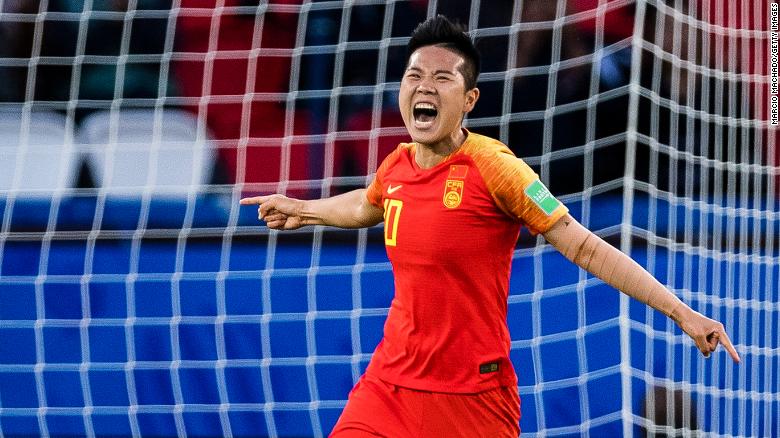
9 July 2021: During this year’s Pride Month, soccer star Li Ying made history as China’s first female athlete to come out publicly as gay, in a candid series of celebratory photos posted on social media, showing her posing happily alongside her partner.It’s increasingly common worldwide for celebrities and high-profile sports stars to come out, often to widespread public support. But in China, Li’s announcement received a very different reaction.
Her post, uploaded on June 22 onto Weibo, China’s heavily censored version of Twitter, immediately went viral, becoming one of the top trending topics on the platform. And while much of the reaction was positive, with people sending their congratulations, Li’s account was also inundated with a wave of homophobic abuse. The post was later deleted without explanation.
Li has not posted on Weibo since. Chinese state-run media, meanwhile, did not report on Li’s announcement, nor the subsequent reaction it generated.
Ernie Chambers has filed a complaint with Nebraska Supreme Court Chief Justice Michael Heavican urging that Dixon County Judge Douglas Luebe be disciplined for “discriminatory dismissal of the adoption petition of a married same-sex couple qualified by law to adopt a minor child.”
“Angry-outrage is an accurate two-word summation of my reaction to discriminatory mistreatment of vulnerable human beings by those wielding power on behalf of the state and ‘the people’ in the role of a judge,” the former Omaha state senator wrote Heavican.
Luebe ruled against allowing the couple to adopt a child, arguing that the “plain ordinary language” of relevant statutes does not allow “a wife and a wife” to adopt.
The Supreme Court subsequently rejected that reasoning, ruling that state adoption laws clearly allow a same-sex married couple to adopt a child.
Kelly Hoagland and Maria Salas Valdez, the married couple, ultimately received approval from Dixon County Judge Edward Matney for the petition allowing them to adopt Yasmin, a 3-year-old.
A civil rights group is threatening to sue a Kansas school district if it doesn’t train employees about LGBTQ rights in response to an eighth-grade student being suspended from riding a school bus after saying, “I’m a lesbian.”…
The ACLU is representing the student, Izzy Dieker, who graduated from eighth grade and plans to attend the district’s high school this fall. She was suspended from her bus for two days in January but didn’t ride again for two weeks because she felt humiliated, said Sharon Brett, the group’s legal director.
A Kansas Association of School Boards investigation found that the bus driver and the principal of Dieker’s K-8 school sexually harassed her, violating federal civil rights regulations and district policies.
Julie Rodgers, 35, grew up in a small, religious Texas town, and when she came out as gay, she was offered meetings at Living Hope Ministries, a so-called “ex-gay” organisation which still exists today.
She was promised that Living Hope would “heal” her homosexuality with conversion therapy, and she would go on to spend almost a decade in the ministry.
She attended multiple meetings every week, moved into the organisation’s “recovery house”, and even spent time living with Living Hope Ministries founder Ricky Chelette.
Rodgers became somewhat of an “ex-gay” poster child, and was coached by Chelette to speak at the notorious Exodus International, which at the time was the largest proponent of conversion therapy in America.
But she began to struggle with self-harm, and as her mental health deteriorated, she realised that the “ex-gay” movement was having a devastating impact on those around her, too.
Although she was determined to leave, when Exodus International president Alan Chambers eventually realised the harm he had done and renounced conversion therapy, he asked Rodgers to tell her story. A year later, Exodus International shut down.
8 June 2021: The Homosexual Integration and Liberation Movement filed a complaint alleging that a 21-year-old non-binary lesbian girl suffered discrimination due to her presentation in a Tottus supermarket, located on Gran Avenida in the El Bosque commune.
Movilh asserts that it is a case of “lesbophobic harassment”, which began when the young woman, who went to the compound with her aunt and two cousins, was harassed by two building guards.
According to her publicised testimony, she said: “When entering the supermarket, the guard asked me for my permit. He pent a long time looking at the permit, observing me from head to toe, but without looking me in the eye. “Angelica? Is this a joke?” I clarified, “Yes, I am a woman,” said the complainant.
“I could not believe the mockery and humiliation that I was experiencing in front of the people in line and my family,” said the young woman.
The guard stated: “Regardless of being a woman, I’ll hit her and beat her up.” (Translated)
El Movimiento de Integración y Liberación Homosexual realizó una denuncia en que acusa que una joven lesbiana no binaria de 21 años sufrió un episodio de discriminación debido a su expresión de género en un supermercado Tottus, ubicado en Gran Avenida en al comuna de El Bosque.
Desde el Movilh aseguran que se trata de un caso de “acoso lesbofóbico” que comenzó cuando la joven fue al recinto junto a su tía y dos primos, siendo hostigados por dos guardias del recinto.
De acuerdo al testimonio que presentaron en una publicación: “Al entrar al supermercado, el guardia me pidió el permiso. Se quedó por bastante rato mirando el permiso, observándome de pies a cabeza, pero sin mirarme a los ojos. De la nada me dijo “¿Angélica?, ¿Es broma esta hueá?”. Le aclaré, “Sí, soy mujer”, señaló la denunciante.
“No podía creer la burla y humillación que estaba viviendo delante de la gente de la fila y de mi familia”, dijo la joven.
El guardia en una última ocasión habría señalado: “No importa que sea mujer, igual le pego y agarro a palos”. (Original)
Yulia Tsvetkova is a young Russian artist and activist from Komsomolsk on the Amur (a city in the extreme east of Russia), who has suffered a homophobic and sexist campaign since March 2019, for defending the rights of women and LGBTI people.
She is accused of committing a crime of “production and dissemination of pornographic material” as a result of drawings of real women which she posted on social media as part of her activism. The criminal trial began on April 12 and she faces up to six years in prison. Given the desperate situation in which she finds herself, Yulia announced that she was on hunger strike on May 1, demanding that the process be sped up, the appointment of a public defender and the opening up of the trial, the hearings of which are held behind closed doors with all media excluded.
Unfortunately, since the process began, Yulia has been the target of homophobic attacks from various people, and of harassment and threats over the phone, on social media and by mail. In addition, she suffered harassment by the Russian police for more than a year, including arbitrary detention, searches at her home and workplace, an enforced psychiatric examination, and almost 4 months of house arrest during which time she could not get necessary medical care.
Previously, in December 2019, she was found guilty of committing an administrative offense, for “propaganda of non-traditional sexual relations between minors”, and was fined 50,000 rubles (780 US dollars) for being the administrator of two LGBTI communities online in the Russian social network VKontakte.
In January 2020 a new administrative action was initiated against her for publishing his drawing on social networks “Family is where love is. Support LGBTI Families”, which represents two same-sex couples with sons and daughters. For this, Yulia was found guilty in July 2020, and was fined again. In parallel, that same month, administrative proceedings for the same type of offense were initiated for the third time. (Translated)
Yulia Tsvetkova es una joven artista y activista rusa de Komsomolsk del Amur (ciudad del extremo oriental de Rusia), que desde marzo de 2019 sufre una campaña homófoba y machista por defender los derechos de las mujeres y las personas LGBTI. Está acusada de cometer un delito de “producción y difusión de material pornográfico” a raíz de unos dibujos de mujeres reales que publicó en las redes sociales como parte de su activismo. El juicio penal comenzó el pasado 12 de abril y se enfrenta a hasta seis años de cárcel. Ante la desesperada situación en la que se encuentra, Yulia anunció el 1 de mayo una huelga de hambre, exigiendo celeridad en su proceso, la personación de un defensor público y la apertura del juicio, ya que actualmente las vistas se celebran a puerta cerrada (tampoco hay prensa).
Lamentablemente, desde que se inició el proceso Yulia ha sido objeto de ataques homófobos de distintas personas, y de acoso y amenazas por teléfono, en redes sociales y por correo. Además, sufrió acoso por parte de la policía rusa durante más de un año, incluyendo una detención arbitraria, registros en su domicilio y su lugar de trabajo, sometimiento a un examen psiquiátrico, y un arresto domiciliario de casi cuatro meses durante el que no pudo recibir la atención médica que necesitaba.
Con anterioridad, en diciembre de 2019 fue declarada culpable de cometer una infracción administrativa, por “propaganda de relaciones sexuales no tradicionales entre menores”, y fue multada con 50.000 rublos (780 dólares estadounidenses) por ser administradora de dos comunidades LGBTI en línea en la red social rusa VKontakte.
Y en enero de 2020 se inició una nueva actuación administrativa en su contra por publicar en las redes sociales su dibujo “La familia es donde está el amor. Apoye a las familias LGBTI”, que representa a dos parejas del mismo sexo con hijos e hijas. Por este hecho, Yulia fue declarada culpable en julio de 2020, siendo de nuevo multada. En paralelo, ese mismo mes, se iniciaron por tercera vez actuaciones administrativas por el mismo tipo de infracción. (Original)
Part two of this extract, the first part of which the Mail & Guardian published last week, lists the names of black lesbians who were murdered between 2007 and 2018, allegedly because of their sexual orientation.
The ad was initially posted to the company’s official website as well as other social media channels. The chain quickly pulled the ad after an intense backlash and replaced the lesbian family with another heterosexual family.
The family at the centre of the storm, Yuma and her daughters Mila and Alina, along with Alina’s fiancee Ksyusha, have reportedly faced ongoing harassment and threats. Mila told the BBC that her family had been subjected to homophobic abuse and “threats to murder my family”. She added that they had also received just as many messages of support. …
The advertisement was released with an 18+ warning label in an effort to fall in line with the “gay propaganda law,” which was signed into law by President Vladimir Putin in June 2013. The controversial law bans the “promotion of nontraditional sexual relations to minors.” Violators of the law can face heavy fines with organisations and businesses subject to fines of one million rubles and forced closures for up to 90 days.
Company Apologises, Pulls Ad The company released an apology on its official Facebook page, signed by the founder of VkusVill, Andrey Krivenko and many of his management team. The post said, “There was an article here that hurt the feelings of many of our customers, staff, partners and suppliers. We regret that this has happened and consider the publication to be our mistake, arising from a lack of professionalism on the part of the brand’s employees. The aim of our company is to help our customers have access to fresh and delicious produce and not to publish materials expressing political opinions or various points of view held by society. In no way did we wish to become a source of discord or hatred.”
The attack took place in Campo Grande, inside a residence on Rua Canjerana, in the Coopharabalho neighborhood, MS. According to the police report, a 20-year-old girl was thrown out of the house and beaten by her father, when he realised she might be in a relationship with another woman.
The father, 52 years old, hit the girl’s head against the wall and dragged her daughter by the hair, according to information from Top Mídia . The girl, who had been thrown out of the house, was attacked when she returned to the house to get her belongings.
(Translated)
O caso aconteceu em Campo Grande, dentro de uma residência na Rua Canjerana, no bairro Coophatrabalho, MS. Segundo o Boletim de Ocorrência, uma jovem de 20 anos foi expulsa de casa e espancada pelo pai, após o patriarca suspeitar que a garota mantinha um relacionamento com outra mulher.
O pai, de 52 anos, bateu a cabeça da jovem contra a parede e arrastou a filha pelos cabelos, conforme informações do Top Mídia. A garota, que tinha sido expulsa de casa, chegou a retornar ao local para buscar os seus pertences, e foi aí que as agressões aconteceram.
BOISE, Idaho — An all-female production crew is working on a documentary telling the story of ‘The Boise 7’.
In 1977, seven women — Mary Morris, Janine Townsend, Lavonne Woody, Vardell Laursen, Judith Baker, Theresa Silva, and Sue Krohn — were fired from the Boise Police Department for “suspected lesbianism.” The firing followed an internal investigation where the seven were wiretapped on a telephone used for personal conversations. The wiretap was later ruled illegal by a judge.
Mary Morris was Boise’s first female patrol officer.
Sue Krohn said her supervisor at the time called her into his office where he played a recording of a phone call between Krohn and another woman. The call was recorded on a phone designated for personal calls.
“I said, ‘What is this all about?’, and he said some of the women had been inappropriate, I think is the word he used at that time with me, at work so we’ve let them go, and I don’t think you’re a part of it, I don’t think you’re a lesbian, but you lived in the house with all these women and plus that phone call — you need to make a decision. Either you can quit, or we’ll terminate you.”
The story quickly garnered national attention. The women had to not only deal with being fired but also being publicly forced out of the closet.
“I couldn’t tell my parents, but I had to. I couldn’t do it. I didn’t want to tell them I was gay, that I was fired, and then my dad disowned me. He wouldn’t talk to me. It was too much. I couldn’t deal with that,” said Janine Townsend.
This is an edited extract from the book Femicide in South Africa (Kwela) by Nechama Brodie.
In 1990, the year that Nelson Mandela was released, Johannesburg held the very first Gay and Lesbian Pride march, at which Simon Nkoli, Beverly Ditsie and Justice Edwin Cameron were among the speakers. The marchers chanted, “Out of the closet and into the streets.”
It was a significant moment, even though it would take several more years before gay, lesbian, bisexual, transsexual and intersex (LGBTI) individuals would be granted similar rights and protections as hetero- and cis-sexual South Africans, first under an interim and then a final constitution that prohibited discrimination on the basis of sexual orientation and gender.
Between 1994 and 2005 a number of legal amendments were made and new laws introduced that formalised rights of lesbian, gay, bisexual, transgender and intersex individuals. The criminalisation of sodomy was declared unconstitutional. Same-sex partners were granted similar rights in terms of immigration and financial benefits as those granted to different-sex spouses or partners. Trans and intersex individuals were allowed to change their legally recognised sex. Same-sex couples were allowed to jointly adopt children or adopt each other’s children. Lesbian couples were allowed to be registered as the natural, legitimate parents of a child that one of them had born.
There were also challenges to the constitutionality of the Marriage Act, which did not then allow for same-sex unions to be recognised as marriages. By late 2005, the Constitutional Court ruled that the Marriage Act was unconstitutional and gave parliament one year in which to remedy the matter.
But being “out of the closet” also meant that LGBTI individuals were more openly targeted for hate, harassment, victimisation and violence — even as these new laws were passed supposedly protecting their rights. Although this text focuses on violence against black lesbians, it is important to note that the growth in hate crimes was experienced by all members of the LGBTI community, with transgender individuals experiencing even higher levels of violence, as a group, than lesbians or gay men.
Black lesbians face double jeopardy This is also a good place to discuss why this is about “black lesbians” and not just lesbians, and also what the concept of “black lesbians” represents as a group, even though it is quite obviously made up of individual black women who are by no means homogenous because of their sexual preference.
In Nonhlanhla Mkhize, Jane Bennett, Vasu Reddy and Relebohile Moletsane’s book The Country We Want to Live In: Hate Crimes and Homophobia in the Lives of Black Lesbian South Africans (HSRC Press, 2010), they note that, although there were risks to “singling out a particular group of people as targets of gender-based violence”, black lesbians were “doubly vulnerable”.
This was because, firstly, although all women in South Africa were vulnerable to violence, there was a correlation between increased poverty and increased vulnerability and, in South Africa, being black meant there was a greater association with being poor or having less access to resources. Not only did black women live in environments in which, just as other black women, they were vulnerable to attack, they also lived in places in which cultures were often deeply homophobic and in which sexual violence had become a “popular weapon”.
In the 1980s, the country’s ongoing rape crisis had started to take on chilling new aspects, including gang rapes that became known as “jackrolling”. Jackrolling initially involved the selection and abduction of a victim, usually a woman who (her attackers believed) presented herself as if she was “better than them” and “out of reach”. There were echoes of these sentiments in the growing number of stories that began to emerge during the 1990s of black lesbian women being targeted, being beaten and raped by men, supposedly as a means of “teaching them how to be proper women”.
This gradually became referred to as “curative” or “corrective” rape, and involved three distinct aspects: one was punishment of the woman, for her choice of sexual identity and her lifestyle; a second was the humiliation of the victim — as with jackrolling, this was often achieved through gang rapes; the third was the repulsive misnomer of “transforming” lesbians into heterosexual women through violent penetration.
Even as newspapers carried the occasional story about black lesbians’ struggles for acceptance individually or within their communities in the context of the changing legislative landscape, almost every single one of these women’s accounts also included incidents of violence, most frequently rape. Sometimes these women were even raped with the knowledge of their family members, who either actively encouraged the assault in the hope of ridding the young woman of her homosexuality, or tacitly accepted such attacks as what should happen to “girls like that”.
The alleged public shaming of several lesbian women by shaving their heads has sparked outrage in the Philippines during Pride Month and prompted an investigation by the national human rights ombudsman.
LGBTQ acceptance has expanded in the Philippines over the years, illustrated in part by the success of some members of the community in politics, media and entertainment industries. But rights groups say gender-based discrimination and violence are still a major problem.
The independent Commission on Human Rights (CHR) said last week it is investigating reports of forced head shaving of women in the town of Ampatuan in Maguindanao province in the southern Philippines.
Videos and photos of the alleged punishment went viral on Facebook and were picked up by local news outlets, where reports said an estimated six women were targeted. Although the video was taken down, it triggered condemnation and calls for action.
A provincial officer who condemned the punishment was quoted as saying that members of the local community suggested it.
The CHR said a local news outlet claimed the public head shaving was carried out because the Muslim-majority town was opposed to same-sex relationships.
2 June 2021 – Harford County Sheriff’s Office is looking for two suspects in a homophobic assault on a Baltimore County woman outside the Abingdon Home Goods store.
The victim told deputies she was in the Home Goods parking lot, in the Constant Friendship Shopping Center, between 12:30 and 1 p.m. May 27 when two people pulled up in a vehicle, yelled homophobic remarks at her, and threw an unknown liquid at her before driving off.
The victim believed the liquid was water, but about an hour later, her skin started itching and she went to urgent care for treatment of what appeared to be chemical burns, according to a press release.
The case ended with a fine of 700 euro – the bus driver had to pay a lot (or too little) for having nsulting a lesbian couple, in Ravenna in the autumn of 2019.
The two girls, after the serious and epeated insults, had reported the 50-year-old, who, when in front of the justice of the peace, chose to apologize and compensate the victims rather than go to trial.
The homophobic insults towards the lesbian couple As Corriere Romagna reports, the homophobic offenses against the two girls occurred at two different times. The first set of insults came in September two years ago, but it was the offense, or rather the threat, of 9 October that triggered the complaint. This is when the driver told them “I would burn you”. (Translated)
La vicenda si è conclusa con un risarcimento di 700 euro. Tanto (o troppo poco) ha dovuto pagare un autista di autobus, colpevole di aver insultato una coppia lesbica, nell’autunno del 2019, a Ravenna.
Le due ragazze, dopo i pesanti e ripetuti insulti, avevano denunciato il 50enne, che davanti al giudice di pace ha preferito scusarsi e risarcire le vittime anziché andare a processo.
Gli insulti omofobi verso la coppia lesbica Come riporta Corriere Romagna, le offese omofobe verso le due ragazze sono avvenute in due momenti diversi. La prima dose di insulti era arrivata a settembre di due anni fa. Ma è stata l’offesa, o meglio la minaccia, del 9 ottobre a far partire la denuncia, quando l’autista ha detto loro “Vi brucerei”.
A quel punto, infatti, una delle ragazze ha deciso di inviare un reclamo alla compagnia, Start Romagna. Fatte le dovute verifiche, la compagnia ha risposto che questo autista non era un loro dipendente. Ma la coppia voleva giustizia, e ha denunciato il fatto ai Carabinieri, i quali hanno identificato l’uomo, notificandogli l’avviso di garanzia. (Original)
As reported by the Berlin police, a14-year-old and her 17-year-old companion were in the park at Gleisdreieck when three strangers approached the two young women, punching and kicking them. Meanwhile, two adolescent men and their accomplice insulted them in an anti-lesbian manner.
The perpetrators were able to flee from the scene undetected. Before that, however, they grabbed and stole the 14-year-old’s handbag and destroyed her cell phone. The two attacked reported the crime and said they were seeking medical treatment themselves. (Translated)
Wie die Berliner Polizei meldet, hielten sich eine 14-Jährige und ihre 17 Jahre alte Begleiterin im Park am Gleisdreieck auf. Plötzlich kamen drei Unbekannte auf die beiden jungen Frauen zu und schlugen mit ihren Fäusten auf sie ein und traten nach ihnen. Währenddessen wurden sie von zwei heranwachsenden Männern und ihrer Komplizin lesbenfeindlich beleidigt.
Die Täter:innen konnten unerkannt vom Tatort flüchten. Zuvor schnappten sie sich allerdings noch die Handtasche der 14-Jährigen, stahlen ihre Handtasche und zerstörten ihr Handy. Die beiden Angegriffenen erstatteten nach der Tat auf einem Polizeiabschnitt Anzeige und gaben an, sich selbst in ärztliche Behandlung zu begeben. (Original)
The 56-year-old driver of a private transport company will stand trial on 3 June in Ravenna for threats he allegedly made on 9 October 2019 to two lesbian girls holding hands. “I would burn you” were the words he allegedly said to the couple as they passed a stop. This threat followed insults he said to the couple at the same place the previous September.
… At the end of the month, the young women first received a phone call from a man who claimed to be the driver in question and then, from the same number, the message “Withdraw the complaint”. This message became part of the alleged series of threats for which he was in court. (Translated)
A processo il 3 giugno davanti al giudice di pace di Ravenna l’autista 56enne di una compagnia privata di trasporti, imputato di minacce che avrebbe rivolto, il 9 ottobre 2019, a due ragazze lesbiche che si tenevano mano nella mano. «Vi brucerei», queste le parole pronunciate dall’uomo contro la coppia mentre transitava davanti a una fermata. Minaccia, che avrebbe fatto seguito a insulti lanciati dall’autista nel settembre precedente contro le due ragazze nel medesimo posto.
… A fine mese la giovane avrebbe ricevuto prima una telefonata da un uomo che diceva di essere l’autista in questione e poi, dallo stesso numero, il messaggio “Ritira la denuncia“. Messaggio entrato a far parte delle contestate minacce. (Original)
Angela Paterson is now 49 years old and living openly as a lesbian, but told the i that she’ll “never forget” her horrific experiences of conversion therapy as a vulnerable teenager.
Paterson joined Lancing Tabernacle Church in West Sussex, which at the time was led by reverend Max Donald, when she was 14.
When she was 19, in 1990, she became homeless. Donald was aware that the teenager was vulnerable, with a history of sexual abuse, and asked her to move in with him and his wife.
Paterson said knew she was a lesbian, and believed what her evangelical church taught her – that being gay meant going straight to hell. Donald initially sent her to a counsellor for conversion therapy, but when that was ineffective, he embarked on four years of abuse in his mission to “heal” her.
The abuse began gradually, Paterson explained: “I’d be in bed and he would come into my room with a cup of coffee, sit on the bed and on the odd occasion touch my hair and say, ‘We really want to look after you.’ Then we would be in the lounge and he would just grab my hand.
“I was confused but I also thought, ‘This is a pastor, someone I can trust.’ Then I was at the fridge one night and he grabbed me and kissed me on the lips. I was really taken aback but he was trying to reassure me, [saying], ‘It’s OK, I just care about you.’”
Donald would tell her that the rape was “OK by God”, and she added: “As far as I was concerned, he was closer to God than anybody else… I thought it might work. I was a broken person when I moved there. So I stayed.”
DURBAN – THE MEC for Social Development in KwaZulu-Natal is calling on residents to rally around the LGBTI+ community following the gruesome murder of a 22-year-old woman.
MEC Nonhlanhla Khoza said KwaMakhutha resident Anele Bhengu’s body was found dumped in the Durban south township.
She was raped and stabbed repeatedly. Her throat and abdomen was also slit.
“The brutal murder of this child is symptomatic of the challenges we have in the society. We are left in shock and fear by the killing of our children in this province,” she said.
Khoza said communities had a responsibility to end these violent crimes in the province.
“We need to get to the bottom of this as to why people have so much hatred towards the LGBTQIA+ community. We call on all citizens to work with the law enforcement agencies, government and different bodies to end such cruelty,” Khoza said.
She said although the government and different activities continue to fight the scourge of these murders, some communities continue to discriminate against some people based on their sexual orientation.
Cape Town – A black lesbian, living in Khayelitsha, was killed in a suspected homophobic attack after her body was discovered on Friday inside her home at a newly-established informal settlement.
The family of Lulama Mvandaba said they believed she was targeted because of her sexuality. Mvelisi Mvandaba said their elder sister’s death came five months to the day after their mother’s death.
“We ask for privacy at this point and will issue a statement about her death once we have had time to grieve, as, unfortunately, she was murdered due to her sexuality and as a member of the LGBTQI+ community.
“To those who knew her vivacious energy and warmth, we extend our heartfelt condolences to you all.
“We are extremely shocked and traumatised as a family and can only imagine how all the kids she touched during her career will be feeling,” he said.
Mvandaba’s death comes after the murder of several gay and lesbian people across the Western Cape.
May 2021: An aspiring young chef is the latest LGBTIQ+ South African murdered in the heartbreaking wave of hate crime violence gripping the country.
On Monday, MambaOnline received initial reports that a lesbian woman had been killed in Cape Town. On Tuesday, the Daily Sun confirmed the news and stated that the victim was 24-year-old Phelokazi Mqathana.
She was stabbed to death in Khayelitsha, allegedly after she rejected the advances of a man while she was out socialising near her home.
“We heard that the man was touching her bum. When she told him to stop, he stabbed her,” Lelethu Ngalo, a family member told the Daily Sun.
The young woman had recently finished a chef course and was described by Ngalo as a “go-getter who had plans to take this family to another level…”
Lwethu Kala, Chairperson of Free Gender, told MambaOnline that Phelokazi had previously attended various workshops hosted by the organisation which speaks out for black queer women.
“She had very big plans, she was the best sushi chef at her school. She was going places,” said Kala.
Phelokazi’s murder is the eighth known LGBTIQ+ killing in a period of less than three months; a wave of hate that has shocked and terrified South Africa’s queer community.











 Listening to Lesbians