Lesbians in the News 18/04/2015

Lesbians in the news

12/04/2015 – 18/04/2015

Violent Crimes against Lesbians:
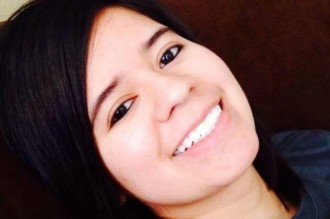
Mary Kristene Chapa

Mary Kristene Chapa

Laws, Politics and Policies:

Representation:

Social and Health Issues:

Remembering our sisters:

Religion:

***If I have missed an important news story, please either post a link in the comments section here or email it to me at liz@listening2lesbians.com.

On stereotypes and lesbian (in)visibility

She was chatting away with me quite happily, this older woman in the shop. I was holding my goddaughter and she was cooing over her. She was bringing out the tired old “just like a girl” tropes but was very friendly and warmly talking about children. I mentioned mine. She smiled.

I mentioned that my ex partner gave birth. She stopped dead.

And she wouldn’t speak to me, or look at me.

From one second to the next, what been an animated and warm conversation became the pointed ignoring of a customer.

I wondered, what was it that upset her so much. Was it that she couldn’t tell? Was it the fear that if you can’t spot a lesbian, then they could be anywhere

While “readily identifiable” lesbians provoke one sort of reaction, and one they are unable to avoid, do “invisible” lesbians kindle an anxiety precisely because we cannot be readily identified and guarded against?

And what is this if not yet another manifestation of gender policing? The idea is that there is one way to be female, with appropriate levels of femininity and heterosexuality. Perhaps if you are going to violate mainstream cultural norms, then at least you should be identifiable in your “non-normality”?  Being unidentifiable is threatening because you are hidden, seemingly deceptive in your perceived “normality”.

Of course, being identifiably other is also punished, in that classic double bind. But we do not all look the same, even if it would make society more comfortable for us to fit a contrived stereotype. One size does not fit all and there is no single way to be or look lesbian. To expect that is to reduce us to two dimensional cartoons.

One size does not fit all – there is no one way to be lesbian

But the hostility we face and the stereotypes we are assumed to fit are self supporting. The hostility we face for being open has a silencing effect. And when we are silent, the stereotypes are reinforced because the only visible lesbians are those who happen to fit the stereotype.

The women who stay silent are not responsible for this dynamic either. We cannot always speak for a myriad of reasons based in the reality of our lives. I try to speak whenever I can, because I can, but I have not always chosen to and it is not always safe or prudent to. The consequences of speaking are somewhat unpredictable and the responsibility lies with the society that vilifies and silences us.

As I spoke today, I could almost see the images through her eyes – the stereotypes cascading through her mind, superimposed on the reality of me, guiding her response to me, to all of us, informing the instantly invoked lesbophobia.

That cusp moment of sudden realisation is so telling in its liminality – it is a moment in which both connection and withdrawing coexist for a short time and when reactions are unwillingly written on the body in facial expressions and body language. It is that moment in which a shared sisterhood is abruptly and palpably sheared off.

Just for a second you can see the sense of betrayal, that shock at feeling deceived, that physical recoil.

These moments of withdrawal are less confronting than overt hostility and aggression, far less damaging than overt violence. But this rejection is not subtle and it shows that no matter how much they liked you and related to you a minute ago, you are now beyond the pale and the social constructs informing their perceptions prevent them from relating now.

At that moment I want to say – we are not hiding – we are just being ourselves. You are using false stereotypes and gender roles to assess and judge those around you. Blame the misleading stereotypes, and not, us for your confusion and discomfort. Challenge the gender roles used to judge women, certainly lesbians and especially gender non conforming women.  Understand that whether you think you can identify us or not, we are not other and you are not morally superior. Understand that your lesbophobia might be common, but it is hate filled and damages women.

But the words echo blankly – she had already stopped listening.

Lesbians in the News 11/04/2015

Lesbians in the news

05/04/2015 – 011/04/2015

Fight Homophobia–Help a Lesbian 

Mary Kristene Chapa and Mollie Olgin (Image source: Curve Magazine)

Mary Kristene Chapa and Mollie Olgin (Image source: Curve Magazine)

In an example of an appalling hate crime in 2012, two two young lesbians went on a date but were viciously attacked. Mollie Olgin was killed and Mary Kristene Chapa was left for dead.

Their attacker was arrested in 2014 but was not charged with a hate crime, despite sufficient evidence to justify it.

Despite the horror of the crime, Mary Kristene Chapa’s medical fund has only raised $12,882, compared to the over $800,000 raised for Memories Pizza, the pizzeria that declined to cater same sex weddings.

Horrific anti lesbian crime occur routinely and they are not reported. When they are, this is the level of interest they garner.

This is lesbophobia and silencing writ large.

Please read more about Mollie and Mary in Victoria A Brownworth’s piece and please donate to help Mary Kristene Chapa with her medical expenses.


Violent Crimes against Lesbians:

Conversion therapy and social homophobia:

  • The Obama administration has called for an end to conversion therapy for lesbian, gay and transgender children. Conversion therapy for lesbians and gay men has a dark history from elimination of “inversion” to ongoing Christian conversion practices. These practices were and are about enforcing gender conformity and discouraging gender non conformity through the linking of sex and required behaviours and attributes (sex stereotypes), and are primarily aimed at eliminating homosexuality. A concern about any concrete bans on all forms of therapy is that it could inadvertently ban the kind of counselling that children diagnosed as transgender may need given that 75-80% of transgender children go on to be not transgender as adults but predominantly lesbian and gay. These children, in particular, need access to supports that validate gender non conformity and homosexuality in the absence of any broad media representation or social acceptance.

Laws, Politics and Policies:

Representation:

  • Kathleen Wynne, Premier of Ontario, Canada and first lesbian Premier, says being lesbian makes her feel more responsible: “It is part of who I am and it is important for me to be clear that I have a responsibility because of who I am . . . to make our society safer and more inclusive”.
  • Two organisations, NCLR and the National LGBTQ Task Force have removed their names from the Equality Michigan petition calling on the Michfest to include transwomen, without having changed their opinion on inclusion. To a non-American the choice of a single (less than) week-long woman’s music event as the symbol of well being for transwoman seems odd in the context of employment discrimination and abuse.
  • Photographic Series “Happy Lesbian Couples” shows, well, happy lesbian couples. Whether you believe this is an argument for marriage equality or not, positive humanising representation in itself is important.
  • Japanese celebrity Ayaka Ichinose and her partner hope to raise awareness through publicity following their wedding ceremony, despite the effect on her career.
  •  Mad, bad or dead: why do we have the Psycho Killer Lesbian plot back again?  “The pathology linked to the lesbian is actually a displacement of the feared pathology of patriarchal culture… The very challenge to order contained in representations of lesbians is restrained by depictions that, in their evocations of nonsense or pathology, disenfranchise the out-of-the-law as the outlaw. This is why lesbians are often figured as murderers and vice-versa. The murderous lesbian characters in Paul Verhoeven’s BASIC INSTINCT (1992), as well as the association of lesbians with vampires…highlight fears that lesbians threaten the death of patriarchy.” Are male supremacy insecurities at the heart of this familiar trope mixing fear and fetish?
  • Love it or hate it – do we need another (better) L word? Are we better served by individual characters in mainstream television or entire shows about us? Perhaps we need both, and to ensure that they are more broadly representative of our diversity than the narrow range of representation we have seen before? Do we know what good representation looks like?
  • On a really trivial front, LGBT emoji have come to iOS but what do they look like? We have identical blondes in pink dresses and women in bunny ears doing synchronised dancing…
  • On a more serious note, religious organisations have shifted their positions as a Baptist college has invited married, lesbian bishop to serve as worship leader and a rabbinical group gets first-ever lesbian president. Does this represent progress, albeit slow, in lesbian acceptance in religious circles and what could the broader ramifications of it be?

Social and Health Issues:

***If I have missed an important news story, please either post a link in the comments section here or email it to me at liz@listening2lesbians.com.

Lesbians and monosexual privilege – as if!

I came across a new concept last year – that of monosexuality.

The idea is that monosexuality is attraction to only people of one sex. So for women this is attraction to either only men or women.

I wasn’t convinced that heterosexuality and homosexuality with their entirely different relationships to power were analogous enough to justify being conflated like this. The social meaning of being heterosexual and conforming to our expected norms is not the same as being a lesbian, a woman who by definition is not centring a man in her life. Hesitations over the concept notwithstanding, I kept reading.

It turns out there is also a a concept of monosexual privilege* which goes further than merely naming the sexual attraction to a single sex – it explicitly frames monosexuality as a negative and an oppressive construct.

There is even a monosexual privilege checklist.

While there may well be problems faced by bi/pansexual people, the framing of them under the term monosexual privilege is deeply problematic where it is applied to lesbians, as the analysis confers power and responsibility where it does not and can not exist.

Homosexuality, and lesbianism in particular, does not occupy a dominant position with respect to other sexualities. That position is reserved for heterosexuality.

Heterosexuality is described as compulsory because much of our society is based on it and conformity to it is enforced. We are socialised to heterosexuality, we are pressured or groomed to be straight. Our structures, our endorsed social meaning, our media – all of it combines to present heterosexuality as the default and required.

No such dominant power structure exists to frame lesbianism as the powerful default, with all that entails, and lesbian sexuality can not meaningfully be framed as oppressive.  Lesbianism being framed as negative, as inferred by using a pejorative word to describe it, is reminiscent of the centuries of society judging that female same sex attraction was immoral, to be prohibited and punished accordingly.

Framing lesbianism as oppressive is ludicrous. There is no institutional and social power that lesbians have in relation to sexuality. We do not have any means to exert power over anyone on the basis of our sexuality, making this a misleading reversal. This framing flies in the face of centuries of silencing, violence, erasure, corrective rape and punishment that lesbians have endured for simply being lesbian.

At the same time as the term “monosexuality” sets up lesbians as negative and oppressive, it also removes our ability to talk about the specificity of our lives, our sexuality. Because heterosexuality is utterly dominant (based on male primacy), even as we are tainted and judged by the term, the frame simultaneously erases lesbians from the debate.

In addition to being framed as negative and oppressive, monosexuality is often framed as staid and stodgy in comparison to bisexuality or pansexuality, as if it were an absence of imagination or diversity, rather than an expression of sexuality. The concept of monosexuality, and the way in which it is used, appears to undermine the social acceptance of particular sexualities and their social meaning, in framing that sexuality as problematic. As always, the implications vary based on power dynamics. I do not witness men called upon to broaden their horizons, particularly not straight men, nor are women encouraged to do this except to titillate men. In practise, it is lesbians whose sexuality is criticised.

In addition to asking why we are being framed in these ways and in whose interests it is, we need to consider what the practical, not just symbolic, implications are for lesbians.

The pressure that results from this approach is clearly uneven – heterosexuality is in an unassailable position as our dominant sexuality, numerically and in terms of power. All of our institutions are set up to align with and support heterosexuality and male dominance. The spurious concept of monosexuality will only have an effect on women, specifically lesbians. The concept represents women being told that their sexuality is flawed and oppressive.

And at this point it becomes clear that the concept of monosexuality, while presented as progressive, is anything but – it is not progressive to criticise lesbian sexuality. It is nothing more than the status quo of male dominance and entitlement seeking to impose itself in a different way.

Sadly, the consequences are real. We now see women who would once have called themselves lesbian now loath to do so, now reluctant to use that term given how it is portrayed and criticised, and this erases us from within….

How can we maintain a lesbian-affirming environment for women and girls if we become so shamed and harassed that we cannot use the word or support our sisters? How can we work to develop better representation of and protection for lesbians if our own existence is under threat?

The word monosexuality is presented as a morally neutral concept used to analyse how sexuality is represented. In practise, it undermines lesbians.

So, before you accuse lesbians of monosexual privilege, please reflect on what it means and what you are actually saying…


* The term privilege can, on occasion, be extremely useful but it is overused and functions to silence debate by denying that one party has any right to discuss the topic at hand on the basis of their purportedly privileged, or powerful, position in the dynamic under discussion.


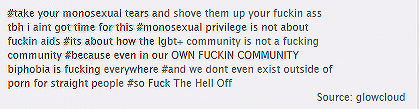
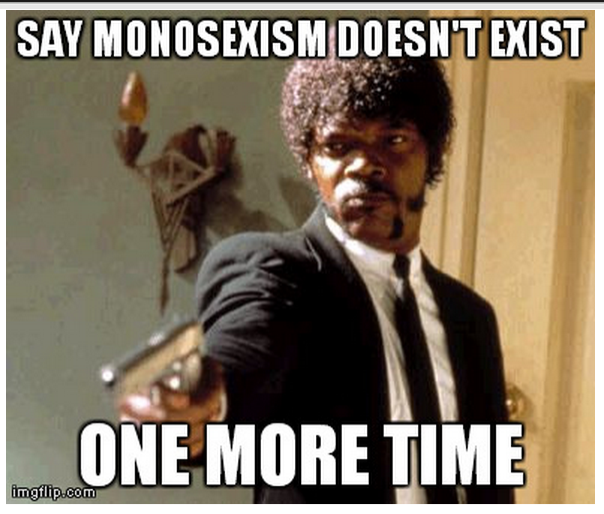
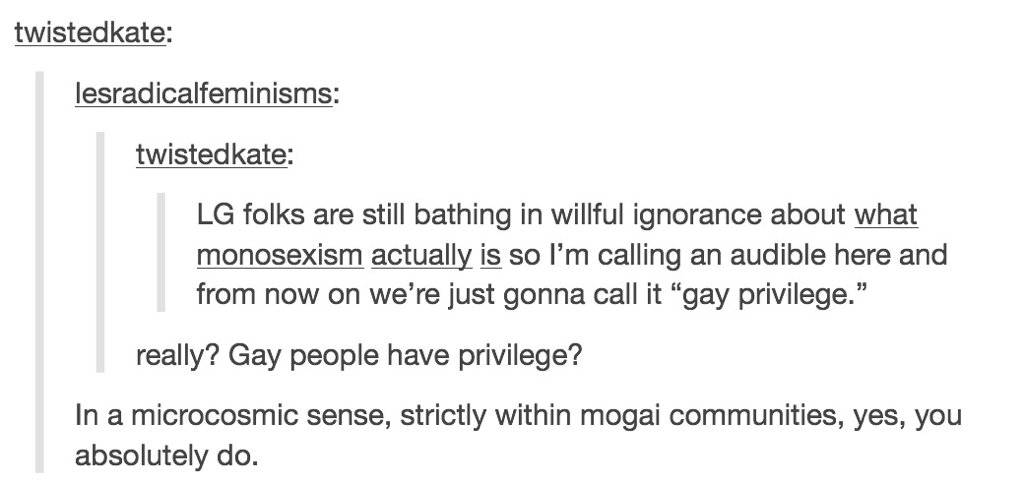
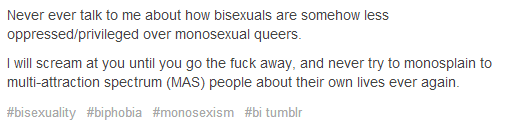
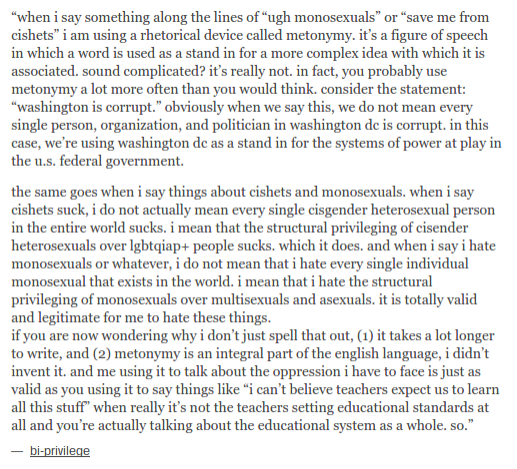
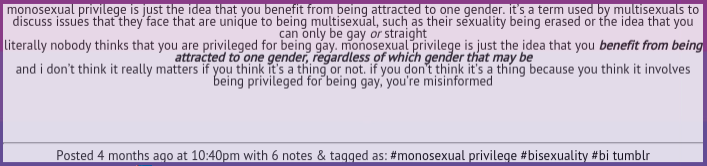
Just in case you think no one would propose monosexuality, below is a collection of links and photos on the topic…

Nothing says dialogue like a gun

Monosexual privilege – not about lesbians and gays but here’s why they benefit?

Radfem lesbians and monosexual privilege

Are we sure this isn’t just anti feminist and anti lesbian?

Monosexual privilege as gay privilege - never mind the reality of heteronormativity

Monosexual privilege as gay privilege – never mind the reality of heteronormativity

Monosplaining....

Monosplaining…..

Metonymy justifies "monosexual privilege"?

Metonymy justifies “monosexual privilege”?

The logic (?) of monosexual privilege

The logic (?) of monosexual privilege

Homonormativity and monosexual privilege

Homonormativity and monosexual privilege

Monosexual privilege - the privilege - not a privilege but a benefit?

Monosexual privilege – the privilege that isn’t a privilege but a benefit?

Monosexual privilege - mostly aimed at lesbians

Monosexual privilege – mostly aimed at lesbians

Monosexual Privilege and who can define it

Monosexual Privilege and who can define it

4thWaveNow — “Monosexual privilege”

4thWaveNow — “Monosexual privilege”

Lesbians in the News 04/04/2015

Lesbians in the news

29/03/2015 – 04/04/2015

Even identity politics doesn’t protect lesbians – Aderonke Apata “not a lesbian”

Aderonke Apata, source: The Independent

Aderonke Apata had appealed to the High Court in the UK when her bid for asylum for sexuality-based persecution was rejected. The UK government argued that she was not a lesbian on the grounds that she had previously been in a heterosexual relationship in her home country of Nigeria, and that she had previously appeared more feminine. Her claim that her ex girlfriend, brother and son were killed and her submissions of sex tapes did not affect the outcome. The Home Office representative declared “The “You can’t be a heterosexual one day and a lesbian the next day. Just as you can’t change your race.”

The judge decided that she was not a lesbian and that she “played the system”, despite a very real fear of persecution if she returns to Nigeria, having been internationally publicised as a lesbian, where lesbians are punished by law and through (increasingly violent) homophobia.

We now have the bizarre position in the UK where you are able to identify as a woman and legally change your recorded sex on public records, if you meet the criteria, but you are not able to identify your own sexuality – clear proof of identifying and living/acting AS A LESBIAN  is insufficient.

In the words of Antilla Dean:

So if you are male, you can identify as a woman and that’s cool.

If you are, actually, a lesbian, and identify as one, and dress as one, and love another female as a female, you are gaming the system.

A campaign in support of Aderonke Apata has been launched by the Proud2Be Project, whose patron she is.


Violent Crimes against Lesbians:

Conversion therapy and social homophobia:

Laws, Politics and Policies:

  • Indiana Passes Anti-Gay/ Lesbian Discrimination Law – Lesbians Are Being Discriminated Against in Every State, Not Just Indiana, by Victoria Brownworth. Not just about wedding cakes and videos, this law which purports to protect religious freedoms permits situations like the paediatrician who recently refused to see the baby of lesbian mothers, and the refusal to hold a funeral service unless a family edit being lesbian out. These are not frivolous or options services, these are basic services that everyone should be able to access at the beginning and the end of their life, regardless of who they are. The refusal to provide them shows a distressing lack of compassion and love. National LGBTI and civil rights groups are lobbying for the  introduction of protections for Indiana’s LGBTI community.
  • The anti-gay backlash continues in America with 20 anti-gay proposals in Texas, including one prohibiting the “burden” of religious exercise without a compelling state interest. Setting the bar this low, without the normal phrasing to prevent only “substantial burden”, could have horrific unintended consequences as religious practices could used to justify a wide variety of unacceptable behaviour.
  • Confederate license plates are seemingly acceptable while the words gay and lesbian are banned. A court case in Texas reminds us of the existing situation in Maryland.
  • The Civil Rights Commission in Michigan released an ordinance template to enable cities and townships to roll out anti-discrimination members for LGBTI residents. 35 municipalities already provide some form of local protection from discrimination.
  • Dallas mayoral candidate Richard Sheridan, an anti-gay activist, has been charged in connection with vandalism linked to homophobia.
  • Bob Jones III has finally apologised for violent homophobia from the 1980s. Although the Bob Jones university continues to actively exclude LGBTI students and alumni, is this apology the start of a shift?
  • The US healthcare system continues to fail meeting the needs of the LGBTI community, including lesbians who are reportedly at a higher risk of breast cancer, have higher rates of smoking, and whose needs for HPV and cervical cancer screening are not met, no doubt for a variety of reasons. As laws supporting religious freedom gain traction, it is likely that the provision of healthcare to lesbians will suffer, as it will for women in general.
  • Indiana Governor defends the state’s religious freedom laws and claims that they aren’t intended to discriminate against lesbians and gays but he is not planning to make lesbian or gay residents a protected class.  If existing legal mechanisms that exist to protect residents from intentional discrimination are not used, the claimed intent to not discriminate seems dubious at best.
  • Meanwhile in Maryland, laws are being developed to provide fertility treatment to married lesbian couples.
  • North Dakota is another state with laws permitting discrimination on the basis of religious freedom, but unlike other states has practically no anti-discrimination legislation with legislation that would ban sexuality-based discrimination soundly rejected by lawmakers for the third time in six years.
  • In an optimistic note perhaps, one of the lawyers who successfully argued against California’s Proposition 8 in the Supreme Court believes that the US will see federal protections for lesbian and gay Americans in the next couple of years.
  • Lawyers for the same sex marriage case in the US Supreme Court prepare for the case to be heard later this month.
  • In a Japanese first, the Tokyo Ward recognises same-sex marriage.
  • What is the affect of same sex marriage – an interesting question posed in lessons From One Year of Same-Sex Marriage in England and Wales. Equality before the law is undoubtedly critical, as is protection of lesbians and our families, but the introduction of same sex marriage is not a silver bullet solving social problems and/or homophobia. In places where the protections for lesbians and their families already exists, the fight for marriage equality ahead of more concrete needs like adequate and appropriate healthcare, for example, seems to prioritise symbolic mainstreaming over these urgent practical needs. Perhaps as national LGBTI communities we need to consider our immediate needs and develop a strategy to achieve them?

Representation:

Social and Health Issues:

  • Homophobia in aged care – the documentary Gen Silent illuminates the homophobia ageing lesbians and gays may face and their consequent return to the closet. Previous studies have raised similar concerns about treatment of ageing lesbian and gay Australians.
  • According to the latest Household, Income and Labour Dynamics in Australia (HILDA) Survey, lesbians earn less than straight or gay men but more than straight women, based purely on working longer hours. This backs up an assessment of society as a structured around male dominance and heterosexuality – that is, supporting heterosexual men and penalising women, irrespective of their sexuality.
  • A University of Illinois study reportedly shows that a sexuality shift early in life is tied to depression. It is curious that they didn’t suggest that the study could be showing how is that coming out is difficult and stressful for many kids, in the absence of a supportive and accepting community.  Most societies groom children to heterosexuality from birth, with social institutions and rituals promoting and supporting them, and social attitudes, structures, laws and behaviours strongly opposing homosexuality in many cases. It makes perfect sense, in that context, for kids coming to terms with or deciding to be open about their homosexuality to have increased rates of depression, especially if familiar, peer and social rejection (both emotional and physical) are taken into account.  It also makes sense for that process to be delayed by the social and cultural hostility surrounding the kids.
  • Lesbian and bisexual women reportedly experience unequal outcomes under Cuba’s healthcare system, with lesbian specific needs and issues either ignored or overlooked. Of particular concern, similar to experiences in other countries, is the way lesbian-specific sexual and reproductive health needs are not met. Many gynaecological processes are discouragingly invasive; lesbian-specific risks for sexually transmitted infections (STI) are not well understood or communicated; and the problems involved in disclosing personal details to health care providers, especially around sexual activity, and discourage women from receiving the required health care.
  • Millenials, the current generation of young adults, are reportedly the generation with the highest rate of “identification” as LGBTI, with the rates doubling since the last survey in 2011.  Much of the change may be in the reported rates of bisexuality, although it is unclear whether the data in the two reports compares similarly segmented generation groups and whether the methodology used to determine LGBT identification was comparable. Interestingly, nearly 40% of millennials also reported that same sex behaviour was morally wrong, with a further 13% reporting that it depended on the situation, significantly undermining the argument that Millennials are a lesbian, gay and bisexual friendly generation. The reported rates of LGB identification are not close to Kinsey’s reported 10%, but factoring in same sex contact but not identity may explain some of this variation, according to a new book on sexual behaviour and statistics.
  • Schools that actively protect LGBT kids may be contributing to lowered rates of depression and suicidality, although it is unclear from the report whether this is based on sexuality specific measures or school wide attitudes against bullying on multiple fronts. What is not reported is the rates of sexual harassment of girls, which will also affect lesbians, and which education institutions around the US, and the world, have systemically failed to address .
  • A Canadian lesbian couple were denied daycare spot due to their sexual orientation and will be filing a complaint with the Manitoba Human Rights Commission.
  • In Switzerland, priests have started blessing same sex couples, with one removed for blessing a lesbian couple in 2014.

***If I have missed an important news story, please either post a link in the comments section here or email it to me at liz@listening2lesbians.com.

Lesbians in the News 28/03/2015

Lesbians in the news

22/03/2015 – 28/03/2015

Lesbians in China – #FreeTheFive:

Xiao La and Maizi

Xiao La and Maizi, image courtesy of Amnesty International

Li Maizi, formally known as Li Tingting, was arrested for “causing arguments in the street” in the leadup to International Women’s Day. Her girlfriend, pictured with her above, is calling for help through All Out:

My name is Xiao La, and I live in China. Two weeks ago, Maizi was organizing a peaceful protest with four friends to denounce harassment at work. They were making pro-equality stickers and planning to hand them out. And just for that, Chinese authorities put my girlfriend in jail.

My birthday is today. Maizi and I had planned to spend the day together doing romantic things. My birthday wish is to have Maizi back. Alone, I won’t be heard. But if thousands around the world join us, the global outcry could get her out of jail.

Can you sign my petition to help free my girlfriend and her friends? go.allout.org/en/a/freethefive/

Maizi and I were taken by the police together, but I was freed the following day. Authorities can now hold her for up to 37 days before deciding whether to even charge her. The authorities confiscated her computer and her phone. The worst part? It happened the night before International Women’s Day.

News articles on the detention:


Violent Crimes against Lesbians:

  • The Brutality of Corrective Rape – South Africa’s progressive laws give no indication of the deep homophobia still dominant within the country, according to this New York Times article. The endemic violence against women couples with the homophobia to result in virulent lesbophobia and, more specifically, corrective rape. Whether it is based on male sexual entitlement or a so called desire to change their sexuality, these South African women talk of being subjected to socially sanctioned and repeated rape. Women are murdered and women have resulting children withheld because of their sexuality.
  • A violent attack on two lesbians in Vancouver is deemed not a hate crime.
  • Homophobia fears keep violence victims quiet – the multiple silencing of same sex domestic violence that prevents victims seeking or receiving help. What can we do as a community to better address the needs of victims? (Note: this story has some Australian DV assistance links).

Conversion therapy and social homophobia:

Laws and Policies:

Representation:

  • Victoria Brownworth’s new novel Ordinary Mayhem is released, focussing on violence against women. Victoria Brownworth’s next book Lesbian Erasure: Silencing Lesbians will be released in late 2015. She says of the novel:”For the past several years I have been increasingly concerned by the obliteration of lesbians as a group by mainstream culture, mainstream feminism and regrettably, even by our own community,” she said. “Major online publications like Slate and Salon conflate lesbian into gay, as if lesbians and gay men don’t have separate identities. And increasingly there is also a revision of butch lesbians as trans men when that is rarely the case—that makes both butch lesbians and trans men invisible. Not all trans men were lesbians, not all butch lesbians are closet trans men. Let each have their distinct identities.””Corrective rape was invented specifically to teach lesbians a lesson about heterosexual normatively. While it’s most common in South Africa, India and Jamaica, it also happen in the U.S., Europe and elsewhere. There are 78 countries where it is illegal to be lesbian or gay—specifically. Lesbians are the victims of honor killings in a dozen countries. The forced marriages of lesbians to men happens in several dozen countries. These are some of the things I write about in Erasure.”
  • NSW, Australia – election candidates answer LGBTI questions – watch the footage here.
  • Herstory: same sex marriage 200 years ago – busting the myth of tradition?
  •  Heather has Two Mommies – kids book about same sex families is now updated with same sex marriage
  • The so-called ‘pink dollar’ or ‘gay-by boom’ – local economies see the benefit in appealing to LGBT tourism. I wonder though, does this actually result in better protections and social conditions for local communities?

Social and Health Issues:

Victoria, Australia held its first Lesbian, bisexual and queer women’s Conference.

Keynote speaker Dr Ruth McNair (from the Australian Lesbian Medical Association) argued that “a conference focusing specifically on women’s health in the community is needed in part because of a history of lesbian, bisexual and queer women’s health being overlooked in funding, policy and LGBTI community services.”

The ALICE study on Alcohol and Lesbian/bisexual women: Insights into Culture and Emotions reported high levels of depression and anxiety, with social stressors (oppression, discrimination and homophobia) closely linked to depression and anxiety rates, drinking levels and self harm and suicidal thoughts.

Other social and health issue stories:

***If I have missed an important news story, please either post a link in the comments section here or email it to me at liz@listening2lesbians.com.


Interview: Queerfest and Violence against Lesbians

Interview: Violence against Lesbians

The New Standard interview: Violence against Lesbians

In a follow up to my post When Lesbians Become Targets: Leeds Queerfest 2015, Serena Ryan from The New Standard and I discuss the meaning of publicly endorsed violence against lesbians.

Baseline: there is nothing that justifies violence against women – actual or symbolic. I don’t think this is complicated.

We might threaten the gender dynamics of male dominance gender dynamics, but the attempt to blame shift is an elaborate attempt to justify and mask the misogyny involved in threatening and silencing women.

We need to be able to discuss our political disagreements like we manage in every other area of political life, rather than responding by silencing women.

There’s nothing progressive about threatening lesbians or promoting violence against us – it’s a centuries old story of woman hating, so let’s move beyond it…

Interview: Violence Against Lesbians

If you have any feedback or would like to know more, please feel free to contact me at liz@listening2lesbians.com.

***Just a reminder, this is a blog about lesbians, and I discuss lesbians alone, as a response to the silencing. Please respect the intent.***

Interview: Peter Abetz and the Lesbian Militia

L2L Interview: Peter Abetz and the Lesbian Militia

The New Standard interview: Peter Abetz and the Lesbian Militia

In a follow up to my open letter to Peter Abetz On Propaganda and Phases, Serena Ryan from The New Standard and I discuss the Western Australian parliamentarian’s views on the promotion of homosexuality, propaganda and the lesbian threat to heterosexuality, or male centring.

Are we leading children astray by telling them it’s ok to be lesbian?

Do we really have a lesbian magic wand that converts children?

Of course not…

Serena and I discuss why we need to support gender non conformity and why representation matters so much for our kids.

We also discuss whether our sexuality is really just a phase, or whether thinking that just reflects an inability to accept that women have sexual boundaries that may not include men.

Interview: Peter Abetz and the Lesbian Militia

If you have any feedback or would like to know more, please feel free to contact me at liz@listening2lesbians.com.

When Lesbians Become Targets: Leeds Queerfest 2015

By anonymous

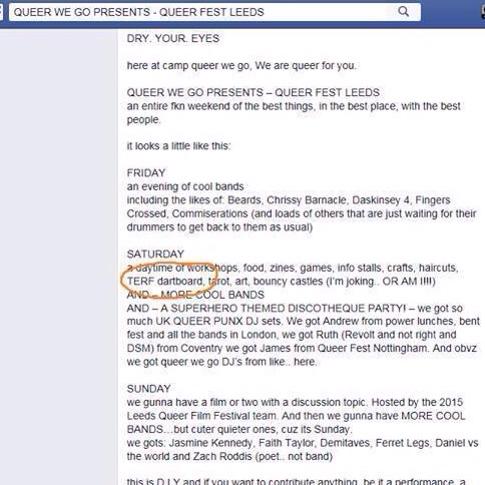
Recently a group of people in Leeds decided to create and promote an event called the Queer Leeds Fest. It was described as “an entire fun weekend of the best things, in the best place, with the best people” and the promotion for the event included a schedule of activities. I was interested and so read through what would be included, but was shocked to see that one activity was called the “TERF dartboard.” After looking further I discovered that event organizers intended to set up a dartboard with the photographs of specific, real women on it and encourage participants to throw darts at those photos. The women pictured in those photos are all lesbians.

Leeds queerfest event with TERF dartboard

I had a sick feeling in the pit of my stomach thinking about this. I don’t personally know the women pictured, but I know of them online and I know that they are lesbian activists and writers. The hatred directed at them by this intention to “have fun” by throwing darts at their photos made me personally feel that I as a lesbian would not be welcome at this event. It seemed to be making a point that certain lesbians invite abuse because of their political opinions. If it could be those women at fault, then it could be any lesbian who had a difference of opinion with the people organizing and attending this event.

Not VAW

Concerned about what seemed to be blatant hatred of lesbians and invitation to symbolically attack them, I decided to read the Facebook page for the event. Someone had posted a question about the “TERF dartboard” — what it would be and why. What happened next convinced me that certain lesbians would not be welcome among the queer community in Leeds. It wasn’t clear exactly why those lesbians wouldn’t be welcome except for differing political opinions, but it was very clear that a whole group of people had decided they hated those lesbians and saw no problem with symbolic violence toward them.

Literal scum

Some of the quotes in the comment thread about the women pictured and anyone else with certain political opinions included, “they are literally scum”

and “we dislike their views; this is us showing that.” A debate formed on the Facebook page among a number of people for quite a while before one of the organizers commented: “we were making a statement against people, who are indeed specific, powerful women.” This made it plain to me that the intention all along was to invite hatred of those specific lesbians. More people commented in response and then another organizer commented to make clear that they did not want certain women at the event: “Thanks for helping us figure out which women to exclude from our event.” Within a few more comments was this: “We’re deciding here is and isn’t allowed in OUR queer community.”

Our queer community

The discussion continued that way for hours and I understood very plainly that there is a level of hatred of some lesbians that I believe could lead to real-world violence against lesbians.

Who is welcome


This is a reader-submitted story from within our own community.

It’s so concerning that even when the implications of this were pointed out, no one stopped to rethink what they were doing, even when women were very specific about what they were seeing, namely the explicit promotion of violence against women.

Dartboard isn't violence

Hate crime women

Against VAW or not

So what does this mean for the LGBTI community?

One commenter summed it up this way:

Patriarchy with glitter

target final

If you have any experiences of being silenced or attacked as a lesbian, inside the LGBTI or broader communities, please contact me on liz@listening2lesbians.com or here.

This blog is about listening to lesbians and, as such, focuses on lesbians alone.

Please respect that intent.

Lesbians in the News 21/03/2015

Lesbians in the news

16/03/2015 – 21/03/2015

Corrective Rape: “I became their playground” – a short film exploration

Corrective rape, the attempt to cure lesbians of their homosexuality, is escalating in severity in South Africa. This film explores the phenomenon through the story of a gay single mother from near Johannesburg.  Busisiwe’s five children are all the offspring of corrective rape. As a lesbian, she was raped in order to be ‘cured’ of her homosexuality. Despite that they’re a product of the hate crime, her relationship with her children is not destroyed: “I only want them to succeed in life, to have the things I didn’t.” In Gauteng near Johannesburg, crime and violence are on the increase and life is tough. With the courage found in her children, Busisiwe helps to educate the young about being safe on the streets.”

Anti-lesbian violence elsewhere in Africa: 

Odorkor Lesbians in Hiding after vicious attacks, as violence against lesbians continues in Accra, Ghana with ongoing police inaction. The violence includes torture by local youth.

Attacks in Swaziland are on the rise with a young lesbian killed in Nhlangano, Swaziland in a horrific hate crime.


Representation Matters – Julie Enszer, Poet, scholar and curator of the Lesbian Poetry Archive Speaks on the stories we tell and why they matter

Anniversary of a lesbian murder – Kitty Genovese died 51 years ago in a vicious hate crime against women.

Longtime political activist Jean Hardisty dies

“Jean was a force in the lives of all who knew her. A visionary, she anticipated many of the political and economic shifts the country has endured over the past several decades. Undaunted by the implications of her insights, she dedicated herself tirelessly—and with uncommon skill, humor, and compassion—to the cause of social justice. She was a friend, mentor, colleague, and inspiration to us, and to countless people and organizations.”

In lieu of flowers, donations may be sent to The Highlander Center, highlandercenter.org or to the Boston Women’s Fund, bostonwomensfund.org .

Lesbian Couple Denied services – Community rallies after Wedding Video denied The big question is – would the community rally if what was demanded was not quite so conforming with standard community values??

Lesbian Movies – the struggle to stay relevant – perhaps more support from the broader community would also help, as indicated by the fact that Perth film maker Tessa Rooney runs an independent lesbian film festival Dyke Drama after the Pride Film Festival failed to show a single lesbian movie

Meanwhile Last call chronicles New Orleans Lesbian bars.

Tasmania, Australia: Schools to be given option to reject students – will sexuality be targeted? 

US Reform Rabbis first Openly Lesbian Leader

Toronto Canada: hate crimes rise by 11%

California’s LGBT Caucus files complaint against OC lawyer who wants to “kill the gays”. Unfortunately, it seems that the petition is hard to stop

Interesting information on why lesbians and gays often don’t live in the same suburbs – the gendered wage gap contributes to the phenomenon…

LGB groups march in Boston St Patrick’s Day parade after years of opposition

NSFW: footage of homophobia at previous marches in the 90s.

Baptist College stands firm on married lesbian bishop speaker: “true Christians” advocate social justice 

Changing Irish views on Same sex marriage Mark decrease in homophobia?

Specialist Toolkit Aimed at helping prevent Lesbian and Gay youth suicides as suicide and self harm rates rise

Puerto Rico may drop opposition to same-sex marriage

Australia: Gold Coast lesbian wins right to be mother of non-biological child

Islamic scholars in Indonesia push for death penalty for sex abuse and gay and lesbian ‘crimes’

US: Cross Burned on lesbians’ Lawn

US: In 16 states, same-sex couples can legally marry and then later that day get fired from their job for doing so. Federa; Panel Discusses LGB protections. 

Celibacy no longer demanded of San Francisco’s Evangelical City Church

Homophobia in the US – what’s it like for LGBT refugees?

Maryland US – A bill that on fertility treatment access for married lesbians progresses and will be voted on this week. 

US: Lesbian sacked for starting a family


Please send me information on any lesbian news I have missed at liz@listening2lesbians.com.

Lesbians in the News to 15/03/2015

Lesbians in the news

To 15/3/2015

Lesbians may have higher risk for cervical cancer?

Researchers discovered that the inaccurate assumptions by doctors about the sexual history of women in same sex relationships resulted in fewer health screenings for lesbians than straight (or bisexual?) women.

The human papillomavirus is the leading cause of cervical cancer and is most commonly transmitted during heterosexual intercourse but can also be transmitted orally and through skin-to-skin contact.

Please be aware of your risk factors and get health screenings as required.

Ghana – Fretful lesbians flee Teshie as homophobic residents vow to hunt them down 

Proud Women of Africa – Khayelitsha

Australian Politician Peter Abetz alleges militant lesbian lobby and anti-hetero propaganda. See more information and my open letter to him here

Lessons learned for LGBT people at the UN Commission on the Status of Women

Pastor Vows to Protest Lesbian Bishop Speaking at American Baptist College: ‘We Do Not Wear Our Sin as a Badge and Parade It’ 

Ireland’s only out lesbian senator has challenged an opponent to a public debate, ahead of the country’s referendum on same-sex marriage.

Oregon court to determine fate of Gresham bakery refusing lesbian couple
Judge will determine if the two women suffered damages 

The name of a lesbian lawmaker’s longtime partner doesn’t appear in a Texas legislative directory, though the publisher updated the web version after the Observer inquired about the issue. 

Taiwan Lesbian couple fights court over baby rights

Lesbian Couple Denied Job Running NZ Holiday Park

Alabama – No same sex marriage but lesbian divorce is pemitted…

2 Lesbian and Gay groups in the Boston St Patrick’s Day parade

Staten Island: Employment Discrimination, including sexual harrassment suit filed

Anti-lesbian abuse from Parisian Train Guard for kiss at Gare Du Nord

Texas Lawmaker introduces bill to ban gay conversion therapy

Catholic Church calls for itself to model love


Please send me information on any lesbian news I have missed at liz@listening2lesbians.com.

On Propaganda and Phases

An Open Letter to Peter Abetz in response to his disparaging comments about homosexuality and anti-bullying measures to be rolled out in Western Australian schools:

“really not an anti-bullying program”

“in fact, when you look at it closer, it really is little more than a gay, lesbian, transgender lifestyle promotion program”

“the militant gay lesbian lobby is trying to get this into our schools to ‘normalise’ what they consider the LGBTI agenda”

“to try and make … heterosexual the abnorm, that is just crazy and defies common sense”

Peter Abetz is the Member for Southern River in Western Australia, and is the older brother of Senator Eric Abetz, a Liberal Senator for Tasmania and Leader of the Government in the Senate.

Peter Abetz’ comments are no doubt concerning to the gay, bisexual and transgender segments of the LGBTI community but Listening2Lesbians is a lesbian specific site and will consequently discuss the implications of his comments for lesbians only.


Dear Peter Abetz,

I was disappointed to read that you oppose the introduction of an anti bullying program in Australian schools.

I understand that there are different ways to tackle bullying. Some methods attack the basis on which kids are bullied (in this case being LGBTI) and some methods attack the behaviour itself, such as more generic anti bullying campaigns that promote diversity without addressing the specific basis for the bullying. It sounds like a simple choice, but I do think it’s more complicated than is often assumed. American legal academic, Martha Minnow wrote about the dilemma of difference and concluded that “the stigma of difference may be recreated both by ignoring and by focussing on it… The problems of inequality can be exacerbated by both treating members of minority groups the same as members of the majority and by treating the two groups differently.”

Whether a campaign that highlights a single realm of difference can end bigoted bullying or not, in the context of a broader lack of representation and ongoing structural discrimination is, therefore, debatable. It is certainly possible that in highlighting the differences between these kids and others, stigma and a feeling of otherness could be exacerbated, rather than diminished.

But the well being of LGBTI kids wasn’t your real concern, as it was reported. You seemed to be worried about the contagious effect of this program, that it might infect straight kids, stating that the Safe Schools anti-bullying program is “little more than a gay, lesbian, transgender lifestyle promotion program”. You also stated that most LGBTI youth grow out of same sex attraction.

This sounds a lot to me like you are arguing that there is a “militant gay lesbian lobby” spreading sexuality-based propaganda, which may corrupt youth, who left alone would be heterosexual.

The “militant gay lesbian lobby” leading kids astray?

This is pure misrepresentation. The only sexuality based propaganda that is widely disseminated in Australia is heterosexual. By the time lesbians become adults, they have experienced 18 years of codified training into heterosexuality that has begun at birth, with expectations clearly expressed in all elements of our society, from legal structures to social expectations.

The training towards heterosexuality is part of the training children receive to meet gender stereotypes, and has specific implications for girls. We are taught at home, at school, and in the community, how to be the “right kind” of girl and, later, woman. Compulsory femininity and compulsory heterosexuality are intrinsically related through constantly reinforced gender stereotypes.

The net consequence is that kids and adults alike understand what the “correct” and socially acceptable way to be a woman or girl is, how she should behave, and what the range of choices available to her are. While the spectrum of acceptability is more diverse than it once was, there are also ways in which the situation has worsened.

In any case, the forced adherence to gender stereotypes can have particularly significant effects on lesbians, specifically those who are gender non conforming  and who do not display the minimum levels of “femininity” expected by society.

It may not be apparent to you, as a straight man, but there are hundreds of tiny ways a week that we are reminded that heterosexuality is the default and preferable and that society is not structured to support our lives. Everything from government structures to social commentary and media representation fails to tell lesbians that our lives are OK, with the effects particularly toxic for young lesbians.

A survey of same-sex attracted and gender questioning teenagers conducted by La Trobe University 2010 found that 60% had experienced homophobic verbal abuse and 18% had experienced physical abuse. It found that respondents were twice as likely to self-harm or have suicidal thoughts if they had been verbally abused, and three times as likely if they had been physically abused.

Eighty per cent of that abuse occurred in schools.

THESE are the young kids I am most worried about. Straight kids have everything around them supporting, promoting and validating them. They aren’t going to be affected by a single poster campaign, because we aren’t contagious and neither is homosexuality. Despite your claims, heterosexuality is not about to be the “abnorm”.

Society provides few positive role models for gender non-conforming women and lesbians, with social structures strongly prioritising the clear expectation that women’s lives will centre around a relationship with a man, the formation of a family and the performance of motherhood. The position of women in our society is still clearly secondary, with abuse of and violence against women ongoing issues.

The effects of living in a society that does not value women, and more so lesbians, results in grim rates of suicide and depression, particularly among our youth.  This tells me that far from being a society in which we need less pro-lesbian propaganda, we need to be working harder to change social structures and attitudes towards lesbians, and gender non conformity in general.

Representation matters – we need to see a full spectrum of what it can mean to be lesbian, if we want to improve how lesbians, most particularly young women, see themselves and are seen by broader society.

So, militant propaganda? I WISH we had some, because it would take decades of it to counter the effects of growing up in a culture where heterosexuality is as promoted and socially enforced as it is.

It’s just a phase

Beyond this though, your comment on homosexuality being a phase was so disappointing. Kids aren’t born with a manual explaining their sexuality, and for some it can take time to work out and accept it. A significant amount of delay in coming out is based on growing up in a culture that promotes heterosexuality so strongly and punishes homosexuality. So, while there are undoubtedly some kids who are not sure about their sexuality – largely based on being young in a society that vilifies, others and belittles lesbians – sexuality is not a phase. There is no natural innate heterosexuality within ourselves that we are failing to conform to.

I’m not prejudiced but…

“I think in Australia most people are quite tolerant. Most people know someone among their relatives or workmates who is a lesbian or gay or whatever, and they don’t bat an eyelid – they just accept them as human beings with inherent value and you treat them with dignity and respect.”

I’m not sure how convincing this is.

After having launched into a moral panic argument which both framed positive representation as an attempt by some “militant lesbian and gay lobby” intent on leading the youth astray, you claimed that much same sex attraction among young people ‘was a phase’. How is it possible for anyone to defend statements such as yours as being anything other than homophobic?

You claim that most Australians are OK with lesbians and gay people, but I suspect that this means that they are OK with the lesbian and gay people who look and sound like them, and don’t challenge their view of the world. That doesn’t really indicate embracing diversity and it isn’t enough to make us safe or welcomed. A begrudging non-discrimination is no basis for full and equal social participation.

It is perhaps easy to speak from a position of social power and criticise efforts to improve the lives of some of our more vulnerable children, but it’s sadly lacking in compassion and speaks to a disregard for the welfare of LGBTI kids, some of whom will be your friends’ kids, your constituents’ kids, perhaps YOUR kids. More importantly, LGBTI children are human beings worthy of your concern in and of their own right.

You may have concerns about this particular campaign, but please don’t mistake our need to tell LGBTI kids that they are OK for propaganda that seeks to influence or confuse straight kids.

None of us have any intention of confusing kids at all. We want to support them to live emotionally healthy and socially engaged lives, whatever their sexuality. Despite your message of grudging tolerance, in criticising this campaign, you have just demonstrated exactly why it was needed.

The subtext of your comments about a militant lobby rendering heterosexuality the abnorm is clear: Be lesbian and gay if you must, but don’t be obvious about it and don’t expect support. Most of all, don’t work to support kids who are discovering or coming to terms with their sexuality.

I reject that.

Growing up lesbian or gay can be very lonely without representation and support. We won’t condemn our kids to that, even if you would.

Liz

Listening2Lesbians.com

Interview: Identifying and combating misogyny in the gay community

interview: Identifying and combating misogyny in the gay community

The New Standard interview: Identifying and combating misogyny in the gay community

Today, on International Women’s Day, I was thrilled to be speaking with Serena Ryan from The New Standard.

Serena, who is known for her interview showing the Salvation Army think lesbians and gay men should be put to death, spoke with me about misogyny in the gay community, as outlined in my piece in the Star Observer, and what we can do to combat it.

The 2015 International Woman’s Day theme is “Make It Happen” – hopefully this website will be help identify and combat abuse and silencing experienced by lesbians.

Interview: International Women’s Day and misogyny in the gay community.

You can help #MakeItHappen by sharing your stories with Listening2Lesbians.

UK lesbophobia endangers asylum seeker


The UK Home Office has used ignorant views on sexuality, socialisation and social pressures to deny the asylum seeking claims of Aderonke Apata as they fight to return her to Nigeria, where she faces persecution for being lesbian.

Ms Apata has been forced to submit concrete “evidence” of her sex life in an attempt to show that she has genuine reason to fear for her safety if she is returned to Nigeria.

The penalty for homosexuality in Nigeria is up to 14 years in prison, with homophobic violence increasing and laws specifically targeting lesbians.

The Home Office rejected her request for asylum on the grounds that she has previously been in heterosexual relationships and has children. They have also relied on stereotypes to reject her bid, citing her initial “feminine” appearance and long hair.

In the High Court challenge to the Home Office’s rejection of her  case, the Home Office’s representative claimed that Ms Apata was not “not part of the social group known as lesbians” but had “indulged in same-sex activity” and that “You can’t be a heterosexual one day and a lesbian the next day. Just as you can’t change your race.”

In countries where being lesbian is frowned upon, and where women are socialised to be heterosexual, married and mothers, it is not at all surprising that many lesbians have been in heterosexual relationships, either under direct or indirect pressure,  or for other reasons. Across the board, women identify their lesbianism at different ages, and women are often prevented from living AS a lesbian by internalised and externalised homophobia, social structures and other elements of their lives.

Where there are laws threatening lesbians with jail or worse, this pressure will be significantly increased as is evident in this case, with Ms Apata claiming that her brother and three year old son were murdered, after she was sentenced to death for adultery by a Sharia court. Ms Apata also claimed that her ex-girlfriend was killed in a 2012 attack.

To reject the asylum claims of a vulnerable woman on the basis of her performance of heterosexuality, where the consequences of failing to perform is extreme, is to punish Ms Apata for her own oppression.  Her legal challenge to the Home office’s decision to reject her initial claim will only exacerbate the persecution she will face if returned.

The approach of the Home Office ignores what we know about the varied path to living as a lesbian . It also invisibilises the pressures women face by assuming women’s life choices are freely undertaken, which we know not to be the case even in the UK, the US and Australia, let alone where the penalties for transgressing proscribed social roles are so extreme.

In returning Ms Apata to Nigeria, the UK government is reinforcing age old sterotypes of what it means to be lesbian and is denying the harsh reality of how lesbians are both punished and repressed.

Their fight to return Ms Apata to a country in which she has been persecuted for being lesbian highlights a structural homophobia in the UK, and makes them complicit in any persecution she faces if returned to Nigeria.

Update: Update: Nigerian lesbian activist wins UK asylum claim after 13-year battle

Sanitised violence

Immense gratitude to this wonderful woman for sharing her experience…


23 years ago. I thought no one suspected I was lesbian, after all, I wasn’t in a relationship at the time and I ‘looked straight’. I was wrong.

As member of the student council, I was required to attend certain formal functions which often included dinner and entertainment which ran into late hours, we slept over in one of the smaller lecture rooms.

One night, on my way to the room, a huge man appeared out of nowhere on the dark staircase landing. He cornered me before I knew what happened. I can’t bring myself to think, much less write, of what happened next. Afterwards, he told me that I was the second dyke that week that he showed what a woman really needs. I was frightened out of my mind, so I agreed with him in hopes he would leave.

‘Corrective’ rape is such a sanitised word, isn’t it?

Lesbians in the news – crime reports matter

****Links in this post may contain disturbing details****

We know that a lot of what happens to lesbians is unseen and unheard, but what happens when stories about lesbophobia and misogyny against lesbians make it to the news?

On the rare occasions when discrimination or violence against us is reported by mainstream media, it isn’t often taken seriously. Hate crimes are mostly not reported as such, and no particular community outcry results.

Both historically and currently, the rates of violence against lesbians (and others in the LGBTI community) have been masked by a fear of reporting a crime that would render the victims vulnerable to further abuse by civil authorities or their community. In general, the consequences of being outed as a lesbian around the world can be horrific, and extend to loss of custody of childrencorrective rape and murder.

Even in Australia, where we may assume it is more safe to be lesbian, the statistics, where they exist, are grim with the 2006 Private Lives report finding that 69% of lesbians modified their daily activities out of fear of prejudice and discrimination.

From when we are young, when we may experience high rates of bullying, to the discrimination in aged care, our  lives can be marked by the perceptions, biases and structures of the society around us.

How crimes against us are reported and responded to by our society is important.

Hate crimes against lesbians – crimes of misogyny, lesbophobia and male sexual entitlement – instruct us in the hatred that lurks in our society, and what may happen to us and our sisters if we step out of line.

The reporting of these crimes often erases the responsibility of the perpetrator, which is a recognised problem with the reporting of violence against women in general.  Invisibilising the perpetrator and their culpability often leaves the focus on the victims, with an implicit question about what they may have done to “deserve” or trigger the crime, often with a prurient slant that fetishises lesbians.

The casual disinterest with which the crimes are often received, if reported at all, instructs us in our relative unimportance. Sporting stories are accorded significant air time. Reports of terrorism are responded to with significant political attention and national resources. Violence against women, including against lesbians, is greeted with silence and inaction, an apathy that speaks volumes about how normalised this violence is.

And lastly, the failure to collate these reports prevents us all from seeing the bigger picture. The interpretation of these incidents as individual events, divorced from the system that motivates them, allows them to be dismissed, ignored and to remain invisible to a society that benefits from the second class status of women.

We need to hear from those lesbians whose experiences form part of the news, because like our personal narratives, their stories form part of the picture that allows us to understand our experiences and fight the structures that support this discrimination and violence.

So, I will be posting news reports of discrimination and violence against lesbians. Please feel welcome to send any reports I have missed to me at liz@listening2lesbians.com.


Respecting your stories

I am asking lesbians to share what can be very personal experiences, some of which will have been quite traumatic with ongoing consequences.

This will require a degree of trust that the information will not be misused, shared without permission and that there will be no blaming or belittling of victims for their experiences.

Many of us have experienced telling our stories only to have them disbelieved, disregarded or interpreted as our fault.  Many of us have been blamed for our own experiences of abuse, either directly or implicitly. This is not an accident, but one of the ways in which women’s voices are intentionally silenced in our societies, with the consequence of preventing us understanding our shared realities.

Without that collective picture, we can struggle to see the pattern of what happens to us, who silences us, and who benefits from both that abuse and the subsequent silence.  Preventing us from analysing and speaking out against this maintains the status quo.

All information shared with this blog will be treated with the utmost care and respect, as will the women who are sharing. All information shared will remain private unless explicit permission is given to make it public, and no information that identifies women will be shared unless they choose this.

I have asked for basic demographic information for future analysis. Information submitted may be used for analysis and advocacy purposes.

Although listening2lesbians is not covered by the Australian Privacy Principles, all personal information will be managed broadly in line with them as outlined here.

If you have any questions about how information you share will be treated, please contact me to talk about it. I want to hear from you.

Why listening2lesbians?

After experiencing abuse while calling out sexism in the online LGBTI community, I wrote a short piece asking the community to reflect on its misogyny.

Hearing women’s responses to the article, I started to wonder about the extent of lesbian abuse and silencing, both in the LGBTI and the broader communities.

What I discovered is that we don’t know the extent of the problem, except anecdotally. Acts of violence, up to and including murder, go practically unnoted, with little or no community outrage.  Abuse and silencing are not uncommon but are practically invisible, in the absence of a way to share what happens to us except on a one-to-one basis.

Without recording our collective experiences, and only hearing them as individualised stories, we cannot readily see or demonstrate patterns.

How, then, can we name, analyse or address a problem we can’t even quantify?

I care about stopping the abuse of women, particularly lesbians.

Listening2lesbians was born to allow women to submit their experiences of being abused or silenced as lesbians, of being subjected to misogyny and lesbophobia within and outside the community.

Please share your stories so we can be heard.

If you have any questions about listening2lesbians, please contact me.