Category Archives: lesbian resistance

International Lesbian Day: Lesbian migration, living freely in Taiwan

Melinda Philippines to Taiwan

“I like life in Taiwan because I can live freely.” Melinda, a lesbian, was not accepted by her father in her native family. After coming to Taiwan [from the Philippines], she felt goodwill for the first time. “I When I first came to Taiwan, my mentor at work was very good with me. He didn’t discriminate against me because of my sexuality. When he told my male supervisor that I like girls, the male executive also said: “Go! Let’s go together and look for a girl for you!”

This is a friendly environment that allows Melinda to be herself; it is also because of this freedom that she wants to stay here and learn to be independent. She took us to the nearby Philippine grocery store to visit. I watched her talk to the clerk in a familiar way, sometimes whispering and sometimes laughing, and introducing us to the food and culture of the Philippines, so confident. Living so confidently is the reason why her mother wanted her to come to Taiwan.
(Translated)

「我喜歡在台灣的生活,因為我可以很自由地活著。」身為女同志的 Melinda,在原生家庭中不被父親所接受;來到台灣後,他第一次感受到善意,「我剛來台灣的時候,工作的導師跟我很好,完全沒有因為我的性向歧視我;而當他跟我的男主管說我喜歡女生時,那位男主管還說:『走!我們一起去找女孩!』」

便是這樣友善的環境,讓 Melinda 能自在地做自己;也是因為這份自在,讓他想繼續留在這裡,也因此學會了獨立。他帶著我們到附近的菲律賓雜貨店參觀,我看著他熟稔地與店員們談天,時而細語呢喃、時而開懷大笑,還向我們介紹菲律賓的食物與文化,如此自信的模樣或許也是他的母親希望他來台灣的原因吧。
(Original)

Continue reading at: https://womany.net/read/article/19973 (Source)

International Lesbian Day: Tribute to Barbara Hammer – “History Lessons” and the History of Cinema

Barbara-Hammer-750x375.jpg

On the 16th [of March], at the tender age of 79, the world lost Barbara Hammer, one of the most important American filmmakers of the last century. If at the beginning of her career her work was seen as marginal, the same cannot be said about today. Over time, recognition of her work has grown and evidence of her current status of reference is her participation in the films Carolee, Barbara and Gunvor (2018) by Lynne Sachs and Vever (2018), a curious triangulation of Hammer’s works, Maya Deren and Deborah Stratman, both being perfect illustrations of her influence on the generations of filmmakers who followed her. Barbara Hammer was one of the first and most prominent voices to actively bring lesbianism to the movies with films like Dyketactics.(1974) or Sisters! (1974), thus changing the history of cinema to places where she had rarely been. The undervaluation of this filmmaker’s work, confining its relevance to the falsely separated universe of queer cinema does not do her justice; if anything, the cultural balkanization that this attitude shows – it is a discreet counterpart of the buzzword “I have nothing against homosexuals as long as it is not in front of me!” – tells us how their struggle persists.

Hammer herself realized the need to rewrite history to accommodate the perspectives of identity groups hitherto neglected by male, white, and heterosexual dominance, and put this rewriting into practice in her 2000 feature film, History Lessons . Consisting almost entirely of archival images, the film aims to attack the narrative that has always and, in the case of cinema, since its invention, tried to hide lesbianism from the public eye, refocusing the images to focus on these women’s perspective – paraphrasing Hannah Gadsby in Nanette, Picasso was not enough to open the culture to other perspectives. The anachronism of image organization, which mixes everything from 1940s magazines to 1960s pornographic films, reveals a stagnant condemnation of lesbians and women in general. However, History Lessons is equally celebratory of each moment of emancipation and even shows some sense of humor.

(Translated)

No passado dia 16, à tenra idade de 79 anos, o mundo perdeu Barbara Hammer, uma das mais importantes cineastas norte-americanas do século passado. Se no começo da sua carreira a sua obra era vista como marginal, o mesmo não pode ser dito sobre os dias de hoje. Com o tempo, o reconhecimento da sua obra foi crescendo e prova do seu estatuto de referência na atualidade é a sua participação nos filmes Carolee, Barbara and Gunvor (2018) de Lynne Sachs e Vever (2018), curiosa triangulação das obras de Hammer, Maya Deren e Deborah Stratman, ambos sendo perfeitas ilustrações da sua influência nas gerações de cineastas que lhe seguiram. Barbara Hammer foi uma das primeiras e mais proeminentes vozes a trazer ativamente o lesbianismo para o cinema com filmes como Dyketactics (1974) ou Sisters! (1974), mudando, desta forma, a história do cinema, levando-o a sítios onde ele outrora raramente estivera. A subvalorização do trabalho desta cineasta, confinando a sua relevância ao universo falsamente apartado do cinema queer não lhe faz jus; se alguma coisa, a balcanização cultural que esta atitude evidencia – trata-se de um discreto homólogo do chavão “não tenho nada contra homossexuais, desde que não seja à minha frente!” – dá-nos a ver como a sua luta persiste.

A própria Hammer apercebeu-se da necessidade de reescrever a história a fim de albergar as perspetivas de grupos identitários até então negligenciados pelo domínio masculino, branco e heterossexual e colocou em prática esta reescritura na sua longa-metragem de 2000, History Lessons. Consistindo quase inteiramente em imagens de arquivo, o filme pretende atacar a narrativa que desde sempre e, no caso do cinema, desde a sua invenção, tentou esconder do olhar público o lesbianismo, recentrando as imagens para se focar na perspetiva destas mulheres – parafraseando Hannah Gadsby em Nanette, não bastou Picasso para abrir a cultura a outras perspetivas. O anacronismo da organização das imagens, que mistura tudo desde revistas dos anos 40 a filmes pornográficos dos anos 60, revela uma estagnação de uma atitude condenatória relativamente às lésbicas e às mulheres de um modo geral. Contudo, History Lessons é igualmente celebrativo de cada momento de emancipação e mostra até algum sentido de humor.

(Original)

Continue reading: https://www.comunidadeculturaearte.com/homenagem-a-barbara-hammer-history-lessons-e-a-historia-do-cinema/ (source)


International Lesbian Day: Australian Lesbian Medical Association Celebrates 20 Years

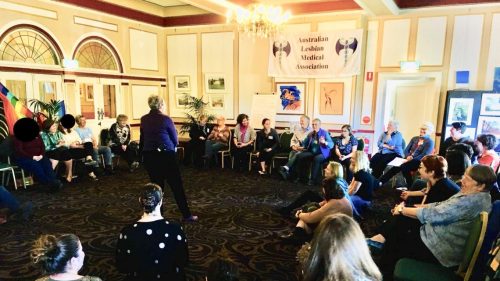
ALMA_1ALMA-members-doctors-and-students-enjoying-a-workshop-on-creative-thinking-and-problem-solving-at-the-Carrington-Hotel-1140x641.jpg

Katoomba’s iconic Carrington Hotel hosted the 20th birthday celebrations of the Australian Lesbian Medical Association (ALMA) in August.

75 doctors and medical students from around Australia and NZ were welcomed to Gundungurra and Darug country by well-known locals, Aunty Carol Cooper and Jo Clancy from Wagana Dancers.

ALMA is a support network for Australian and New Zealand lesbian doctors, medical students and their partners and is involved in advocacy and research to improve the health of lesbian and same-sex attracted women nationally and internationally.

ALMA also runs http://www.doclist.com.au, a list of health care professionals who have been recognised and recommended by women within the LGBTQI community.

Continue reading: http://www.starobserver.com.au/news
/national-news/australian-lesbian-medical-association-celebrates-20-years/187614 (source)

International Lesbian Day: María Galindo – Lesbian and Feminist Militant

galinda.jpg

On December 17, 2015, this Bolivian activist, artist and performer, psychologist and radio host was called to testify in La Paz, accused of “destruction or deterioration of state assets and national wealth.” The crime: a street intervention signed by Women creating. The denounced graffiti said “Femicide is a crime of the patriarchal state” and referred to the murder of Andrea Aramayo Álvarez in August of the same year.

María appeared at the Prosecutor’s Office with an uneven scale that hung from her left hand and on her chest a necklace of shattered dolls, a symbol of the outrages on which justice does not have, in Bolivia or anywhere, substantial interference.

With a huge Phrygian on which an open sign was supported like a fan that said “Prosecutor’s Office rhymes with crap”, Maria climbed the three floors by stairs to the screams until she reached the room to give a statement. Although those who have seen her once, always remember her, when Galindo is asked about her daily performativity and about the use of her own image as a fighting tool, she responds to having built it as anyone would do with her own, as if she simply It will be a lady with tied hair and a tailor suit.

(Translated)

El 17 de diciembre de 2015, esta activista boliviana, artista y performer, psicóloga y conductora de radio fue llamada a declarar en La Paz, acusada de “destrucción o deterioro de bienes del Estado y la riqueza nacional”. El delito: una intervención callejera firmada por Mujeres creando. El grafiti denunciado decía “El feminicidio es un crimen del Estado patriarcal” y aludía al asesinato de Andrea Aramayo Álvarez ocurrido en agosto del mismo año.

María se presentó en la Fiscalía con una balanza desnivelada que pendía de su mano izquierda y sobre el pecho un collar de muñecas destrozadas, símbolo de los ultrajes sobre los cuales la justicia no tiene, ni en Bolivia ni en ningún lado, sustancial injerencia.

Con un enorme frigio en el cual se apoyaba un cartel abierto como un abanico que decía “Fiscalía rima con porquería”, María subió los tres pisos por escaleras a los gritos hasta llegar a la sala a prestar declaración. Aunque quienes la han visto una vez, la recuerdan siempre, cuando a Galindo se le pregunta por su performatividad cotidiana y sobre el uso de su propia imagen como herramienta de lucha, ella responde haberla construido como cualquiera haría con la suya, como si simplemente se tratara de una señora de pelo atado y trajecito sastre.

(Original)

Continue reading: https://www.paginasiete.bo/ideas
/2019/8/11/maria-galindo-militante-lesbiana-feminista-226902.html
(source)

International Lesbian Day: Lesbian couple flees Iran, finds home in Columbus

iran.jpg

Sherry Bayegan and Rezi Haghiri sold their popular Persian restaurant in Tehran and all their belongings and left their Iran six years ago. The couple had been under suspicion by the Iranian government for what officials called their “Western” ways, including that they were lesbians, punishable by death in Iran. They said leaving their families was especially difficult. Today, Bayegan and Haghiri live together in the Short North and are working to get a restaurant similar to the one they had in Iran off the ground in the United States.

Continue reading: https://www.dispatch.com/news
/20190922/lesbian-couple-flees-iran-finds-home-in-columbus
(source)