
By anonymous
Recently a group of people in Leeds decided to create and promote an event called the Queer Leeds Fest. It was described as “an entire fun weekend of the best things, in the best place, with the best people” and the promotion for the event included a schedule of activities. I was interested and so read through what would be included, but was shocked to see that one activity was called the “TERF dartboard.” After looking further I discovered that event organizers intended to set up a dartboard with the photographs of specific, real women on it and encourage participants to throw darts at those photos. The women pictured in those photos are all lesbians.
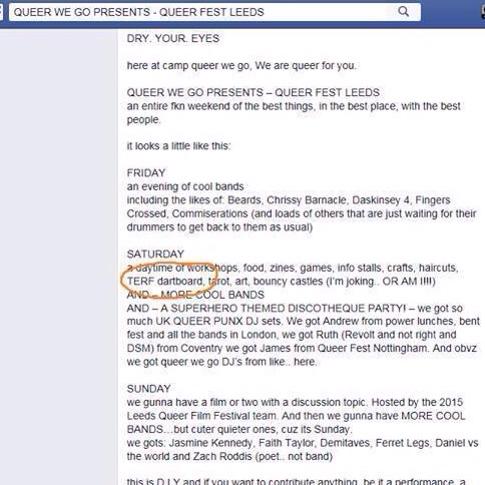
I had a sick feeling in the pit of my stomach thinking about this. I don’t personally know the women pictured, but I know of them online and I know that they are lesbian activists and writers. The hatred directed at them by this intention to “have fun” by throwing darts at their photos made me personally feel that I as a lesbian would not be welcome at this event. It seemed to be making a point that certain lesbians invite abuse because of their political opinions. If it could be those women at fault, then it could be any lesbian who had a difference of opinion with the people organizing and attending this event.

Concerned about what seemed to be blatant hatred of lesbians and invitation to symbolically attack them, I decided to read the Facebook page for the event. Someone had posted a question about the “TERF dartboard” — what it would be and why. What happened next convinced me that certain lesbians would not be welcome among the queer community in Leeds. It wasn’t clear exactly why those lesbians wouldn’t be welcome except for differing political opinions, but it was very clear that a whole group of people had decided they hated those lesbians and saw no problem with symbolic violence toward them.

Some of the quotes in the comment thread about the women pictured and anyone else with certain political opinions included, “they are literally scum”
and “we dislike their views; this is us showing that.” A debate formed on the Facebook page among a number of people for quite a while before one of the organizers commented: “we were making a statement against people, who are indeed specific, powerful women.” This made it plain to me that the intention all along was to invite hatred of those specific lesbians. More people commented in response and then another organizer commented to make clear that they did not want certain women at the event: “Thanks for helping us figure out which women to exclude from our event.” Within a few more comments was this: “We’re deciding here is and isn’t allowed in OUR queer community.”

The discussion continued that way for hours and I understood very plainly that there is a level of hatred of some lesbians that I believe could lead to real-world violence against lesbians.

This is a reader-submitted story from within our own community.
It’s so concerning that even when the implications of this were pointed out, no one stopped to rethink what they were doing, even when women were very specific about what they were seeing, namely the explicit promotion of violence against women.



So what does this mean for the LGBTI community?
One commenter summed it up this way:



If you have any experiences of being silenced or attacked as a lesbian, inside the LGBTI or broader communities, please contact me on liz@listening2lesbians.com or here.
This blog is about listening to lesbians and, as such, focuses on lesbians alone.
Please respect that intent.


 Listening to Lesbians